

Table of Contents
- The Fixture Is a Project of Its Own
- A Fast Robot Cannot Recover a Long Setup
- The Best Robot Specialist May Already Know the Process
- Your Team Will Form an Opinion Before the Cell Arrives
- Installation Is a Joint Operation
- A Practical Readiness Review Before Delivery
- The Robot Is Only One Side of the Result
In this article:
- Why an automatic fixture is a separate engineering task, rather than a small accessory to the robot.
- Why setup time can limit the return from a robotic cell.
- Why the best people to learn the robot may already be running the process.
- What internal communication and installation support change during start-up.
The robot cell has been ordered. The project schedule is running, the integrator is designing and building the system, and delivery may still be weeks away.
It is easy to see this period as waiting time.
For the manufacturer, it is preparation time.
The cell will eventually arrive at a production environment that already has its own machines, fixtures, product changes, people and daily pressures. How well those elements have been prepared will affect how quickly the new system becomes reliable production.
This is where the manufacturer’s part of the project becomes especially visible.
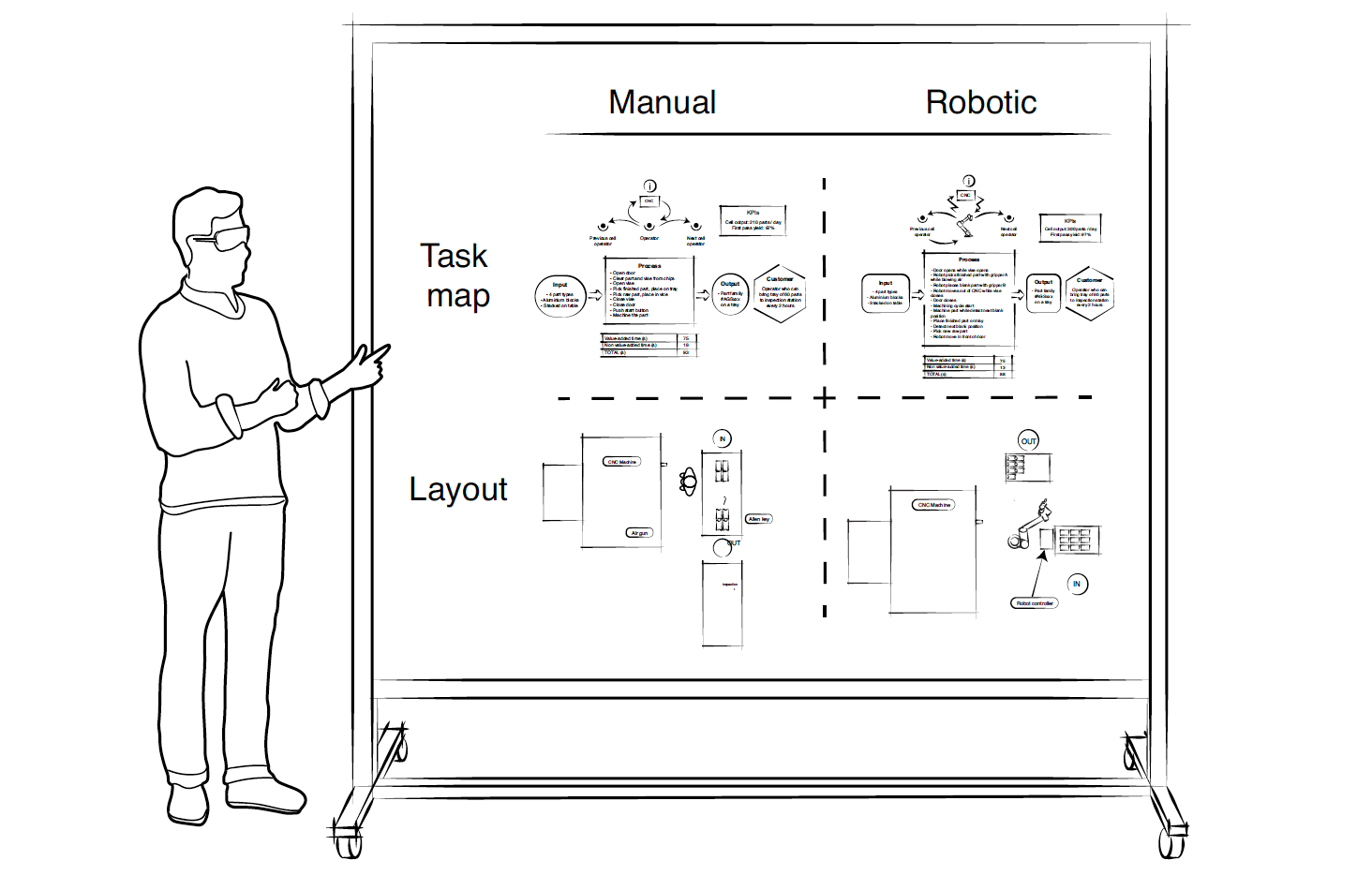
Figure 37. Communicating with visual comparisons of the current manual cell map and layout and the future robotic cell ones.
Source: Samuel Bouchard, Lean Robotics: A Guide to Making Robots Work in Your Factory (2017), fig. 37.
The Fixture Is a Project of Its Own
Robot investments often require new fixtures. In many applications, these fixtures must clamp automatically and exchange signals with the cell control system.
That sounds like one item in the equipment list. In practice, fixture design can determine whether the robot places the part consistently, whether the machining operation begins safely and how easily the system changes from one product to another.
The design team must understand what the robot needs. The tool room must have the time and resources to manufacture the equipment. The integrator needs the relevant geometry and interface information early enough to test the complete sequence.
If those activities begin too late, the robot may be ready while the process around it is not.
For this reason, fixture preparation needs an owner, a schedule and clear technical responsibility. It should progress with the robot-cell project, rather than appear as a small task to be completed shortly before delivery.
A Fast Robot Cannot Recover a Long Setup
Changing the part on a machine usually involves more than selecting another robot program. Fixtures may change. Cutting tools may change. Machine settings and inspection requirements may change as well.
These activities already affect manual production. Automation makes their effect more visible.
A robot can repeat a loading cycle consistently, but it cannot create production while the complete cell is waiting for a long setup. If product variety is high and changeovers are frequent, setup time can become the limit on the value the robot returns.
That is why I recommend beginning this engineering work early. Which fixture changes can be simplified? Which tooling can be standardised? Which adjustments can be prepared outside the machine? Which parts can share the same gripper fingers or locating arrangement?
The answers belong to the manufacturer, the integrator and the teams responsible for the machine and tooling. Waiting until commissioning to begin this discussion usually means using production time to solve a preparation problem.
The Best Robot Specialist May Already Know the Process
A robotic cell creates new technical responsibilities inside the factory. Someone must understand daily operation and recovery. Someone must be able to recognise when maintenance or integrator support is needed.
Manufacturers therefore ask whether they should recruit new robot technicians, transfer employees from another department or train the people already working on the process.
Our service engineer Hakan once explained the difference very clearly:
“When the operators or setters already working on the process receive robot training and gain the necessary technical competence, the result is usually faster and more permanent than hiring someone from outside or transferring someone from another production department. They already know the part, the machine and the production process, so they adapt to the robotic system quickly. Sometimes they also identify risks that even we did not foresee, because they know the process so closely.”
That last point matters.
Robot knowledge is valuable, but it does not replace process knowledge. The person who has loaded the machine, dealt with variations in the part and recovered production after small interruptions already understands details that may never appear in a process document.
Training can add robot competence to that experience.
Together with the integrator, decide which operators, setters, maintenance employees and engineers need to be involved, and what each group should be able to do before the cell enters production. The training plan should follow those responsibilities rather than give everyone the same general introduction.
We discuss the project relationship and role-specific training in more detail in Working With Your Robot Integrator: From Order to Long-Term Support.
Your Team Will Form an Opinion Before the Cell Arrives
A first robot investment can create understandable uncertainty inside the factory.
People may expect their responsibilities to change. Some may wonder whether the experience they have built over many years will still be valued. If the purpose of the project is not discussed, that uncertainty can become resistance.
Internal communication therefore belongs in the preparation plan.
Explain why the investment is being made and what the company expects it to improve. Discuss how physically demanding or risky activities may change. Explain which new technical skills the team will need and where experienced employees will contribute to the new process.
The message should not be limited to “a robot is coming.” The team needs to understand how the investment fits the company’s longer-term direction and what their role will be once it is running.
When employees can see themselves inside that future process, the transition becomes easier to manage.
Installation Is a Joint Operation
Eventually, the system reaches the factory.
The integrator’s installation team may need support from the people who know the production equipment: a machine setter who can help with an adjustment, access to utilities, or something as simple as the correct drill at the right moment.
Preparing that support does not mean transferring the integrator’s responsibility to the customer. It means making sure the people and resources specific to the plant are available when required.
This helps the installation progress without avoidable delays. It also begins the working relationship that will continue through service and later modifications.
In many integration companies, the people working beside your machine during installation are closely connected to the service team you will call later. How the two teams work together during start-up therefore has value beyond the installation itself.
A Practical Readiness Review Before Delivery
Before the cell is shipped, I would bring the manufacturer and integrator together for one final readiness review.
Preparation area | What should be clear before delivery |
|---|---|
Fixtures | Design status, manufacturing status, automatic operation and required interfaces |
Product changeovers | Fixture, tooling, program and machine-setting changes for the intended part range |
Internal team | Who will operate, set, maintain and technically support the cell |
Training | Who attends, which competencies each role needs and when training takes place |
Internal communication | What the project changes and how its purpose has been explained to the team |
Installation support | Machine availability, utilities, access, plant contacts and required workshop support |
This is not a second specification. It is a check that the factory is preparing the environment described in the original project.
If you are still defining that original scope, begin with Before You Request a Robot Cell Quote, Define the Project.
The Robot Is Only One Side of the Result
The integrator is responsible for designing, building, programming and commissioning the agreed robotic system.
The manufacturer brings the production knowledge and prepares the environment in which that system will work: the fixtures, setup method, internal team and support around installation.
Neither side can replace the other.
A well-built robot cell arriving at an unprepared process will lose time. A well-prepared factory receiving an unsuitable system will face a different set of problems. The result depends on the two preparations meeting at the same point.
The weeks before delivery are therefore not simply the end of the integrator’s build schedule. They are the manufacturer’s opportunity to make sure the cell arrives at a factory ready to put it to work.