

Table of Contents
- What Does the Extra €30,000 Buy?
- A 40 kg Part. Two Ways to Feed the Machine.
- Part-exchange sequence
- Why a 40 kg Part Can Require a Much Larger Robot
- How the Simpler Concept Reduces Project Cost
- How Twenty Seconds Become 3,800 Parts
- Production comparison
- Now Compare the Prices Again
- Ask How Much Time Your CNC Will Actually Spend Machining
While preparing a recent proposal at Robsen, I was reminded of a question that comes up repeatedly in automation projects:
Two integrators quote for the same application. There is a substantial price difference. Why?
The shortest answer is that they are offering different things—and different levels of added value.
The difference may involve attention to safety, shorter commissioning, professional project management, better training, or experience gained from delivering similar solutions repeatedly. That experience can translate into faster delivery and fewer service interventions.
Two systems may achieve the same output and still justify different prices through these benefits. We are preparing separate articles on these subjects.
Today, I want to focus on production performance: how twenty seconds in a handling sequence can make a difference of approximately 3,800 parts per year.
What Does the Extra €30,000 Buy?
A manufacturer still developing its approach to robot investment, perhaps preparing for its first automation project, may initially focus on two questions:
- What is the turnkey system price?
- How quickly will the investment pay for itself?
Both are reasonable. What matters is how thoroughly the production assumptions behind those answers are examined.
Among our customers, those with an established approach to robot investment tend to ask early about the proposed sequence, machine waiting time and expected output.
Consider two illustrative project prices: €100,000 and €130,000.
As the engineering company that may submit the higher figure, we should have a better answer than “ours is better.”
That additional €30,000 needs to earn its place in the proposal.
Here is how the handling concept can contribute to that value.
A 40 kg Part. Two Ways to Feed the Machine.
In the project that prompted this article, an operator manually loads and unloads a CNC machine with the assistance of a crane. The workpiece weighs approximately 40 kg.
Our task is to automate this operation.
One approach uses a 100 kg-payload robot with a single gripper. It removes the finished part, puts it down, collects the next raw part and loads the machine.
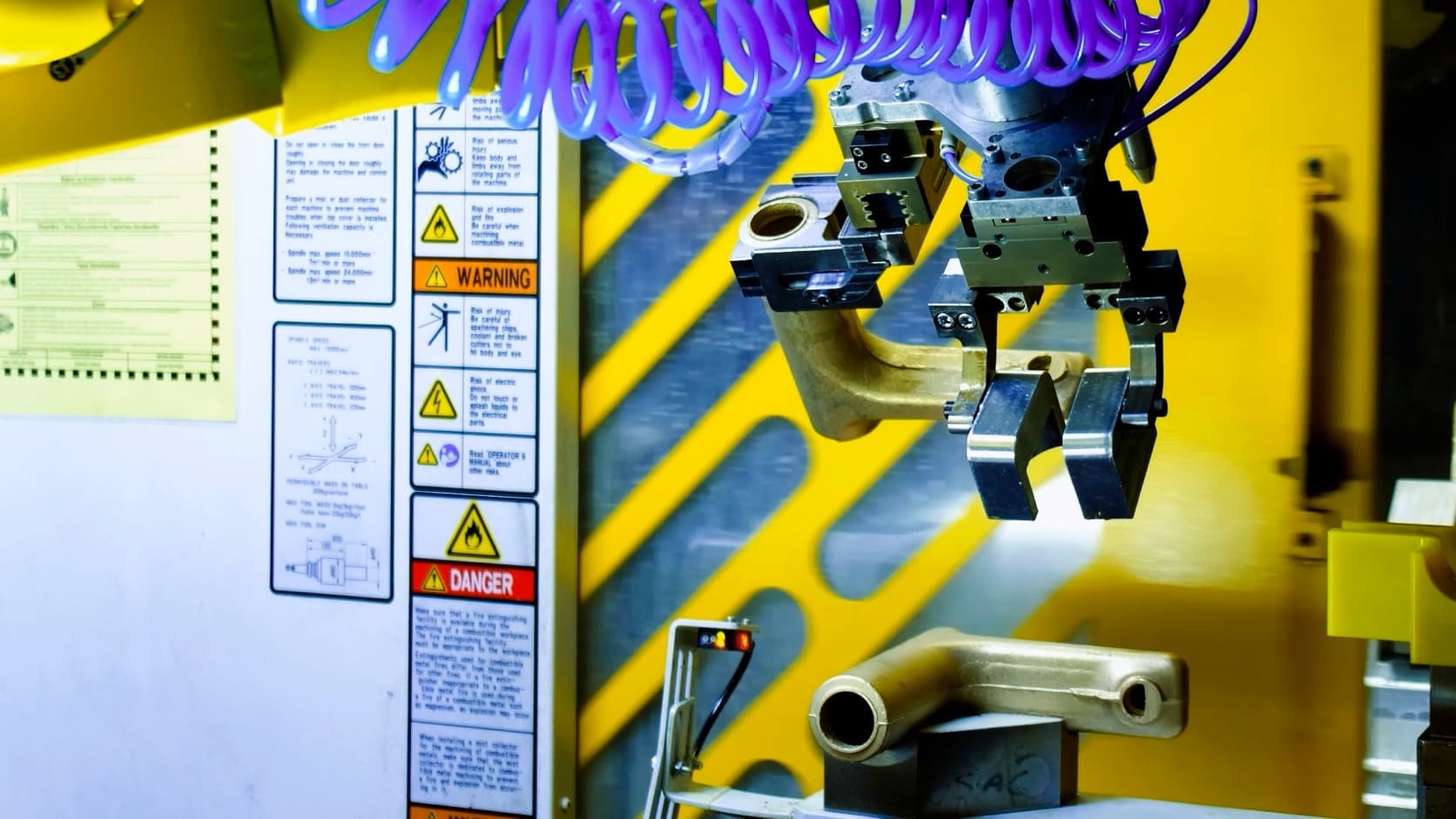
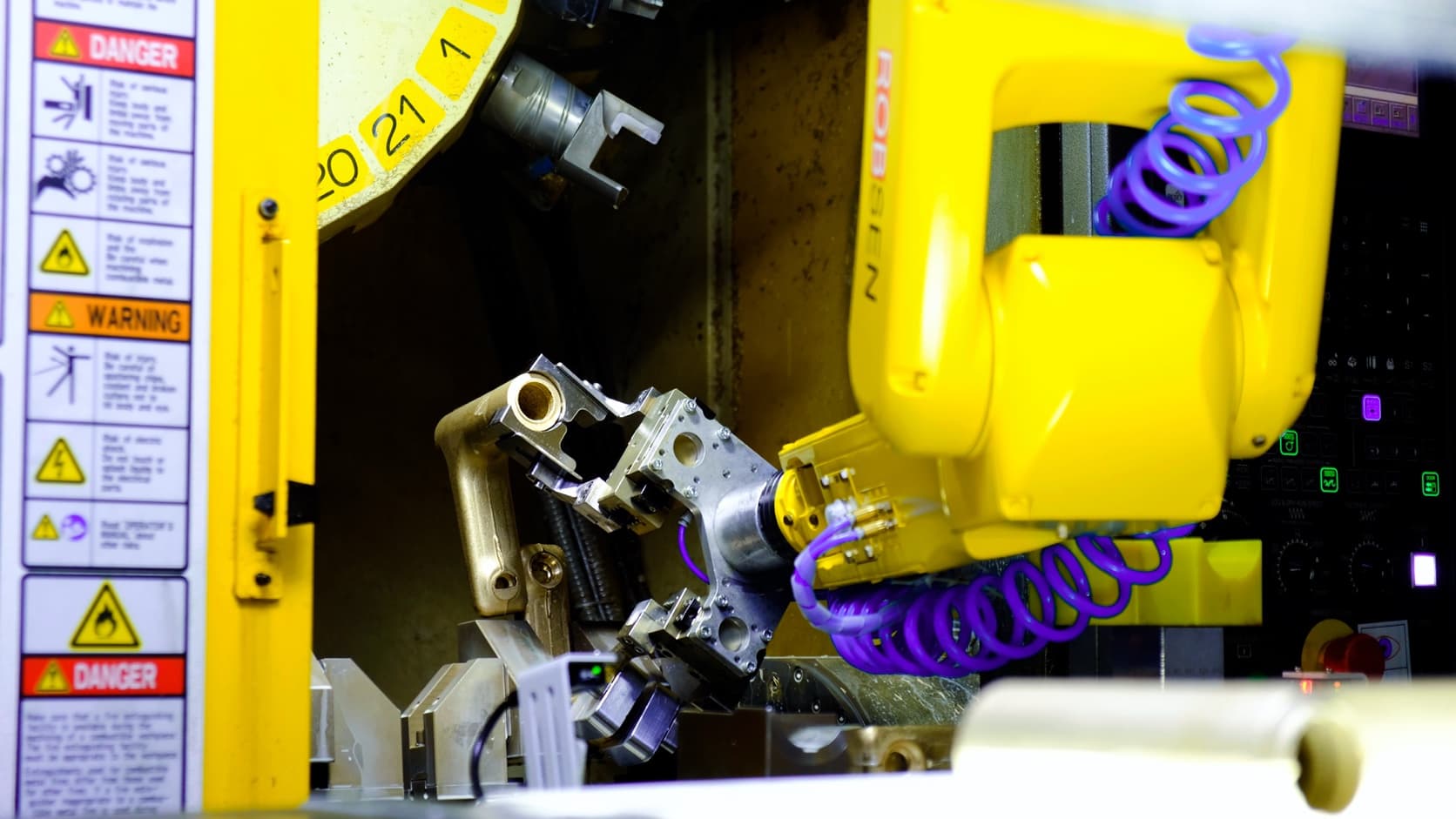
Another uses a 210 kg-payload robot with a dual-gripper tool. It arrives with the next raw part already in one gripper and removes the finished part with the other.
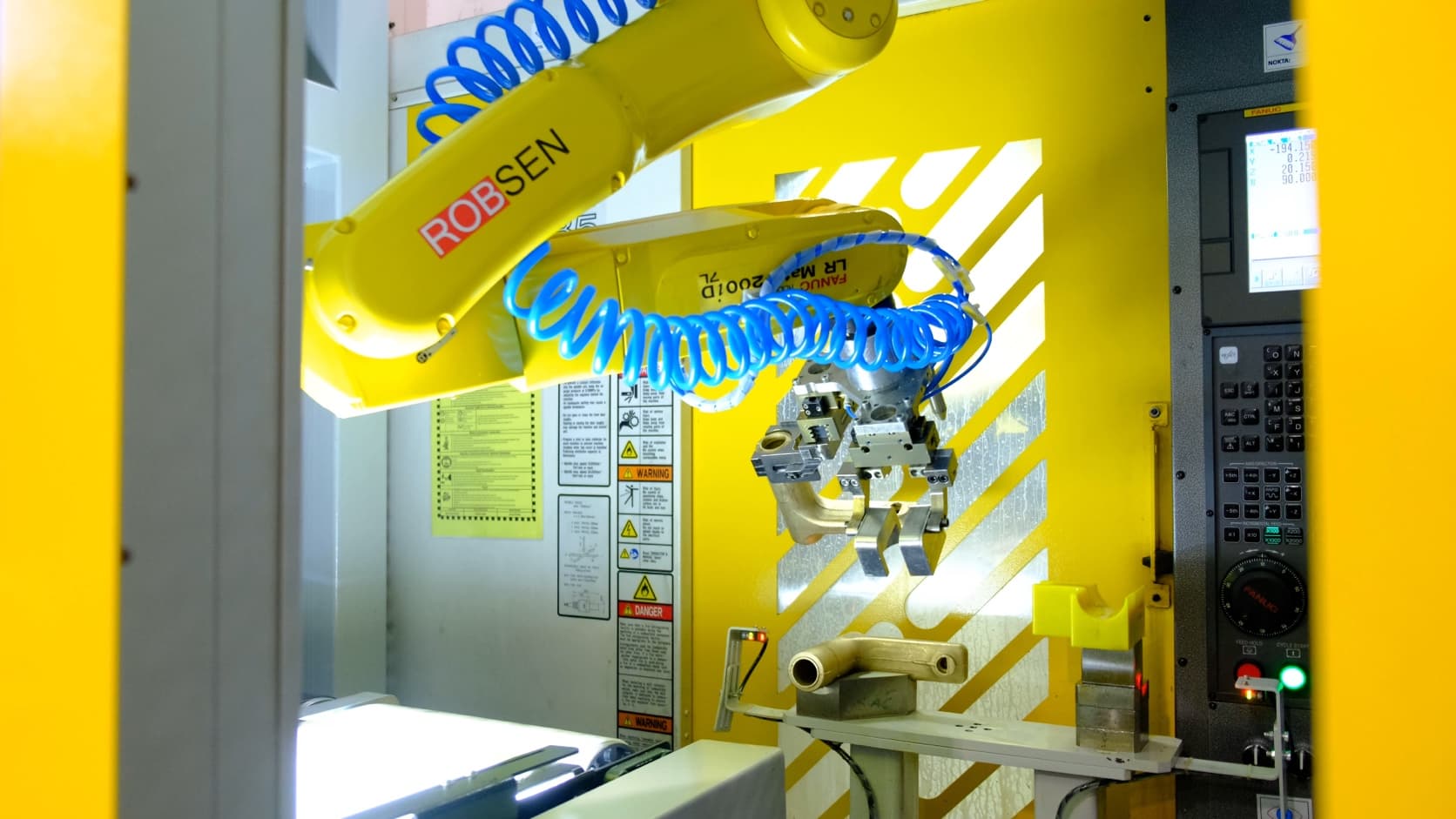
If one gripper can do the job, why choose two grippers and a larger robot?
Because the two approaches leave the CNC waiting for different amounts of time.
Part-exchange sequence
Stage | Single-gripper concept | Dual-gripper concept |
|---|---|---|
While the CNC is machining | The gripper remains available to remove the finished part. | The robot collects the next raw part in one gripper, leaving the other empty. |
When the machine door opens | The robot enters and grips the finished part. | The robot grips the finished part with its empty gripper. |
After removing the finished part | The robot travels to an unloading position, releases the finished part and then collects the next raw part. | The robot withdraws with both parts and rotates the tool approximately 180°. The next raw part is already held in the second gripper. |
Loading and restarting the CNC | The robot returns, loads the raw part, withdraws and allows the door to close. | The robot immediately reloads the machine, withdraws and allows the door to close. It unloads the finished part while machining continues. |
For the large workpiece in this example, the dual-gripper tool withdraws from the machine before rotating. With smaller parts and sufficient clearance, that rotation may be possible inside the machine.
The dual-gripper concept moves external unloading and raw-part collection into the time when the CNC is already machining.
That is the production benefit behind the larger equipment choice.
Why a 40 kg Part Can Require a Much Larger Robot
For representative equipment, consider the FANUC R-1000iA/100F, with a rated wrist payload of 100 kg and a reach of 2,230 mm, and the R-2000iC/210F, with a rated wrist payload of 210 kg and a reach of 2,655 mm. FANUC R-1000iA/100F datasheet, FANUC R-2000iC/210F datasheet
A robot carries more than the workpiece. Its wrist also supports the grippers, fingers, mounting plates and other attached components.
During the dual-gripper exchange, it carries two workpieces as well as the complete tool. Two approximately 40 kg parts already represent approximately 80 kg before tooling is included.
Where that load sits matters too.
(A 100 kg payload rating refers to the total load carried at the robot wrist, within the manufacturer’s specified limits. The load’s centre of gravity is assessed relative to the mounting flange and wrist axes—not simply by its distance from the robot base. Moving the load farther from the wrist increases the moment it creates and can reduce the permissible mass. The model’s wrist-load diagram and moment and inertia limits define the acceptable arrangement.)
Reach and payload therefore need to be evaluated together with tool geometry. A catalogue rating alone cannot establish whether a particular gripper and workpiece arrangement is suitable. FANUC specifies separate wrist moment and inertia limits alongside payload. FANUC technical specifications
This is why a 40 kg workpiece can require a larger robot than its weight initially suggests.
In our comparison, the smaller robot serves the single-gripper concept, while the larger model provides the capacity needed for the proposed dual-gripper arrangement.
How the Simpler Concept Reduces Project Cost
The cost difference extends beyond the robot purchase price.
A single-gripper tool requires fewer gripping components, custom fingers and pneumatic components. Its supporting structure can also be simpler.
The robot’s supporting construction is another consideration. The two example models weigh 665 kg and 1,090 kg respectively. Their bases and anchoring must accommodate different operating loads, which can affect plate thickness, material specification and welding requirements. FANUC R-1000iA/100F datasheet, FANUC R-2000iC/210F datasheet
Layout and guarding costs may also differ. The robot itself may cost less, although payload alone does not determine its purchase price.
So the simpler concept can create real savings across several project items.
What needs to sit beside those savings is the cost of the additional machine waiting time.
How Twenty Seconds Become 3,800 Parts
Assume each part requires 300 seconds of machining.
With the single-gripper concept, let the complete door-opening, unloading, loading and door-closing sequence take 50 seconds.
With the dual-gripper concept, carrying both parts during the exchange eliminates the trip to unload the finished part and collect the next raw part while the machine waits. The shorter robot path reduces that interval to 30 seconds.
For the annual comparison, use three eight-hour shifts, 300 production days and an 85% production factor allowing for other operating losses. This gives 6,120 effective production hours per year.
Production comparison
Production measure | Single-gripper concept | Dual-gripper concept |
|---|---|---|
Machining time per part | 300 seconds | 300 seconds |
Part-exchange time, including door operation | 50 seconds | 30 seconds |
Total cycle | 350 seconds | 330 seconds |
Estimated annual output | 62,949 parts | 66,764 parts |
Annual output = effective production hours × 3,600 ÷ total cycle time.
The difference is approximately 3,815 additional parts per year—6.1% more output from the same CNC machine.
Twenty seconds may look minor in a sequence description. Repeated throughout the production year, it becomes a significant capacity difference.
Now Compare the Prices Again
Return to the illustrative €100,000 and €130,000 proposals.
The additional investment is €30,000. The annual capacity difference in this example is approximately 3,815 parts.
Where demand and downstream capacity support that output, its annual contribution is:
3,815 × contribution margin per additional part.
Compare that contribution with the extra investment and any differences in operating costs.
For this investment comparison, we use a 15-year economic life. Over that period, the annual capacity difference adds up to approximately 57,000 additional parts.
The purchase-price saving occurs once. The production effect of the chosen cycle continues year after year.
Ask How Much Time Your CNC Will Actually Spend Machining
Ask each integrator to show the complete cycle: machining time, part-exchange time and the resulting productive machining hours over a shift or year.
In this example, machining occupies approximately 85.7% of the modelled cycle with the single-gripper concept and 90.9% with the dual-gripper concept.
For a machining business, the machine earns its keep when the tool is engaged and removing material. Completing that operation also releases the part to the next process.
The CNC’s productive time should therefore guide the investment in auxiliary equipment. Robot selection, gripper design, loading positions and machine interfaces should all support a shorter interval before machining resumes.
Among our customers who have achieved the strongest results after investing in robotic systems, we repeatedly see this understanding: they assess the supporting equipment by how effectively it keeps the machine producing.
At Robsen, our contribution starts with that engineering assessment, before the equipment list is finalised and the system is built.
In this example, those decisions are worth twenty seconds per cycle—and approximately 3,800 parts per year.
Before choosing the lower project price, ask how much productive machining time each proposal delivers.