

Table of Contents
- In This Article
- What FAT and SAT Actually Mean
- FAT and SAT at a Glance
- Before the Customer FAT, We Test the Complete Cycle Ourselves
- 1. FAT Brings the Specification and the Finished System Together
- 2. FAT Is Also a Training Environment
- 3. FAT Helps the Customer Test Its Own Readiness
- 4. A Long SAT Does Not Affect Only the Integrator
- 5. The IROCUBE Platform Is Designed to Shorten Site Work
- Day 1 — Positioning and utilities
- Day 2 — Machine integration and commissioning
- Day 3 — Production observation and final handover
- We Like Our Customers—But the Production Floor Belongs to Production
In This Article
- What FAT and SAT mean in a robotic automation project.
- Why a written specification still requires an integrated acceptance process.
- Why customer training is more effective before the system reaches production.
- How FAT helps manufacturers identify their own site-readiness requirements.
- Why a thorough FAT can significantly shorten commissioning and production downtime.
- How the IROCUBE platform supports a faster transition from delivery to production.
Factory Acceptance Testing can sometimes be mistaken for a final demonstration.
The robot moves. The part completes its cycle. The customer watches. Everyone signs the document, and the system is prepared for shipment.
A proper FAT must go much further than that.
At Robsen, FAT is one of the most important stages of a robotic automation project. It is where the mechanical system, robot software, PLC controls, machine vision, safety functions and process requirements are evaluated as one complete system.
It is also where the customer begins learning how that system will become part of its production environment.
We already have another acceptance stage after installation: SAT.
So why do we place so much importance on FAT?
Because SAT should confirm that the system works at the customer’s site. It should not become the place where unfinished engineering, unresolved expectations and preventable training challenges are discovered for the first time.
FAT asks whether the robotic cell is ready to leave Robsen. SAT asks whether the complete production environment is ready to operate together.
What FAT and SAT Actually Mean
Factory Acceptance Testing (FAT) is performed before shipment, while the robotic cell is still at the integrator’s facility.
Its purpose is to verify the system against the agreed project scope and test as much of the complete operating sequence as possible under controlled conditions.
Site Acceptance Testing (SAT) takes place after the system has been delivered, positioned and connected at the customer’s facility.
SAT confirms that the cell can operate correctly with the customer’s actual machine, utilities, production environment and site-specific interfaces.
FAT and SAT at a Glance
Comparison | FAT | SAT |
|---|---|---|
Location | Integrator’s facility | Customer’s production site |
Timing and purpose | Verify the cell before shipment in a controlled environment | Verify operation after installation with the actual machine, utilities and production environment |
Focus | Specification, functions, cycle, recovery and training | Operation with the actual machine, utilities and production environment |
Extended work | Generally easier to control | May require additional machine downtime and site resources |
FAT does not eliminate the need for SAT.
It protects it.
The more technical questions we answer before shipment, the more focused the work at the customer’s facility can become.
Before the Customer FAT, We Test the Complete Cycle Ourselves
Before inviting the customer to FAT, our own project team operates the complete robotic cycle.
We do not evaluate only individual robot movements. We test how the complete sequence behaves when its functions work together:
- Part presentation
- Part detection and orientation
- Robot picking
- Gripper operation
- Machine-interface signals
- Loading and unloading
- Process sequencing
- Cycle-time consistency
- Alarms and fault recovery
- Operator interaction
- Safety-related functions
A movement can work correctly on its own and still create a challenge when it becomes dependent on another operation.
A robot may reach every required position, for example, but the complete cycle may still reveal timing conflicts between part presentation, machine signals and gripper operation. A vision system may detect the part correctly during an individual test but require further adjustment when lighting, conveyor movement and robot timing are evaluated together.
The full-cycle test allows these relationships to be observed before the customer arrives.
1. FAT Brings the Specification and the Finished System Together
Our projects are managed according to an agreed technical specification.
The specification defines matters such as:
- Equipment
- System functions
- Performance criteria
- Cycle-time expectations
- Product variants
- Optional modules
- Machine interfaces
- Safety requirements
- Training
- Acceptance conditions
However, a robotic automation project is a dynamic engineering process involving many participants.
Depending on the application, the project may include:
- Customer production and maintenance teams
- Mechanical design engineers
- Electrical and automation engineers
- Robot programmers
- Machine-vision specialists
- Safety engineers
- Quality teams
- Purchasing departments
- Machine manufacturers
- External equipment suppliers
Even when the original specification is clear, new information can emerge during design meetings, email discussions, simulations and technical reviews.
A customer may clarify an operator requirement. A machine manufacturer may provide new interface information. A mechanical revision may create a dependency for the robot program. A vision requirement may affect lighting, cycle time or part presentation.
These are not necessarily signs of poor communication. They are part of a dynamic project in which several technical disciplines and organizations are developing one integrated system.
The important issue is whether every approved requirement has reached the final cell correctly.
FAT creates a structured point at which we bring those decisions back together.
We compare the completed system with:
- The approved specification
- Documented project revisions
- Agreed performance criteria
- Recorded customer requests
- Defined acceptance scenarios
- The relationships between connected operations
If a difference or missing dependency is discovered, the system is still at Robsen. Our engineers, workshop resources, spare components and design tools are immediately available.
That creates a much healthier environment for completing the required development than discovering the same matter after shipment.
The purpose of FAT is not to prove that no project ever changes. It is to ensure that approved changes become part of one verified system before delivery.
2. FAT Is Also a Training Environment
Many people may interact with a robotic cell after it enters production.
They do not all need the same training.
An operator needs to understand:
- Normal cycle operation
- Loading and unloading
- Start, stop and reset procedures
- Common alarms
- Safe recovery steps
- Basic changeovers
Maintenance personnel need a different level of information:
- Sensor and actuator diagnostics
- PLC and robot alarm structures
- Mechanical adjustment points
- Backup and recovery procedures
- Safety functions
- Preventive maintenance requirements
- When to request integrator support
Production engineers may focus on recipes, part variants, cycle time, process limits and production data.
Supervisors and managers may need to understand the system’s capacity assumptions, operating requirements and acceptance criteria.
If all of this training begins for the first time at the customer’s production site, an uncomfortable situation can emerge.
The operator is touching the robot for the first time. At the same moment, a technician, production engineer, supervisor and plant manager may all be standing behind them.
It is not always the easiest environment in which to say:
“I did not understand that. Can we try it again?”
At Robsen, we organize training according to the participant’s role and technical responsibility.
The sessions take place in a calm, quiet and controlled environment. There is no pressure from a waiting production machine. Participants can repeat operations, create controlled faults, ask questions and practise recovery procedures.
An operator does not need to receive the same training as an automation engineer. A production manager does not need every detail of robot programming.
Each participant should leave FAT knowing what they are responsible for and how they should interact with the system.
3. FAT Helps the Customer Test Its Own Readiness
FAT does not evaluate only the integrator.
It also gives the manufacturer an opportunity to simulate what will happen when the robotic cell arrives.
While the system is operating at Robsen, the customer can identify its own remaining preparations:
- Is the electrical supply ready?
- Is the compressed-air connection available?
- Are network and data connections prepared?
- Is the machine interface complete?
- Are the required fixtures and jaws available?
- Has the production area been cleared?
- Are access and maintenance spaces protected?
- Are the correct production parts available?
- Have internal safety responsibilities been assigned?
- Which operators and maintenance personnel will support commissioning?
- When can the CNC machine be made available?
- Has the installation and production-start window been agreed?
These questions are much easier to manage before the truck reaches the factory.
A customer who participates actively in FAT sees the complete sequence, understands what the system requires and returns to the plant with a more concrete preparation list.
This is one of the reasons FAT shortens SAT.
The integrator prepares the robotic cell. The manufacturer prepares the environment in which that cell must operate.
Successful commissioning requires both.
4. A Long SAT Does Not Affect Only the Integrator
In a machine-tending project, SAT generally requires the customer’s production machine to be made available.
In practical terms, that often means stopping a CNC machine that normally creates value every day.
Every additional site day can involve more than the integrator’s service cost. The manufacturer may also be carrying:
- Lost machine output
- Operator and technician time
- Maintenance support
- Production-planning disruption
- Additional shift arrangements
- Delayed orders
- Repeated training
- Travel and accommodation costs
- Extended ramp-up risk
For this reason, the purchase price of the robotic cell is not the only figure that should be examined when comparing quotations.
Manufacturers should also ask:
- How many commissioning days are planned?
- What must be completed before the integrator arrives?
- When is the first automatic cycle expected?
- How long is planned between the first cycle and stable production?
- Which tests will already have been completed during FAT?
- Which customer personnel must support SAT?
- What conditions could extend the commissioning period?
- Which training will be completed before shipment?
A lower initial quotation does not necessarily produce a lower total implementation cost if the system requires a long and uncertain commissioning period at the customer’s site.
Commissioning time is not only a service cost. It is also production time borrowed from the customer’s machine.
5. The IROCUBE Platform Is Designed to Shorten Site Work
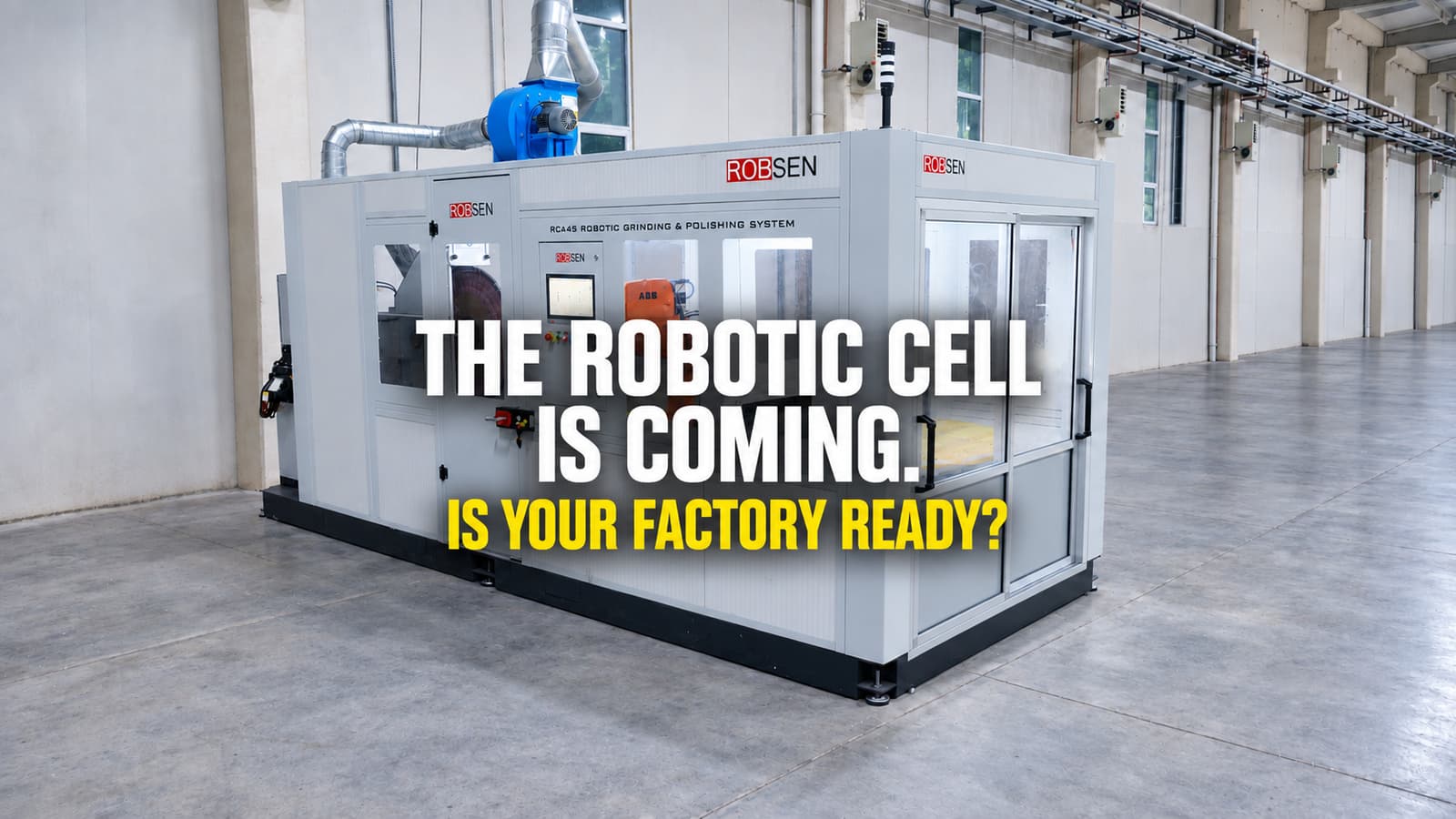
One way we reduce site work is by building the robotic cell as an integrated platform.
When the process and robot dimensions allow it, the robot, feeding equipment, controls, guarding and supporting modules are installed on a common base before shipment.
The IROCUBE robotic-cell family is based on this platform approach.
This allows a significant part of the work to be completed at Robsen:
- Mechanical assembly
- Robot positioning
- Cable routing
- Pneumatic connections
- PLC and robot communication
- Safety integration
- Vision-system setup
- Gripper testing
- Process sequencing
- Full-cycle testing
Instead of transporting separate equipment to the customer’s facility and constructing the complete cell around a production machine, we arrive with an integrated and previously tested system.
For suitable machine-tending projects, we organize site commissioning around a compact sequence:
Day 1 — Positioning and utilities
The cell is positioned and the prepared electrical and compressed-air connections are completed.
Day 2 — Machine integration and commissioning
Communication with the production machine is completed, the interface is verified and the automatic production cycle is commissioned.
Day 3 — Production observation and final handover
The production cycle is observed, final training is completed, open points are reviewed and the closing meeting is held.
The exact scope of every project is different, but this is the commissioning structure we design toward.
The objective is not to carry unresolved development work to the customer’s factory. The objective is to complete as much engineering and verification as possible before shipment so that site work can focus on the actual machine and production environment.
We Like Our Customers—But the Production Floor Belongs to Production
We enjoy spending time with our customers.
Once the robot is operating, we are also happy to sit in their office and have tea or coffee together.
What we do not want is to spend unnecessary days beside a stopped production machine completing work that could have been finished during FAT.
The production floor belongs to the machines, operators and engineers who create value there. Our responsibility is to complete the integration, verify production and return that floor to them as quickly as possible.
A successful SAT begins with a serious FAT.
When evaluating a robotic automation proposal, do not examine only the equipment list and purchase price.
Ask the integrator how the system will be tested before shipment. Ask who will participate in FAT, what training will be provided, which acceptance criteria will be measured and how many days of machine availability will be required during SAT.
A professional robotic integrator should already have clear answers to those questions.