

Table of Contents
In this article
- Why approving the budget is not the same as being ready for the system.
- What happens when critical parts of the work are handed to third parties.
- How an integrator should answer when you ask for cheaper components.
- What regular reporting, a test plan and change management look like in practice.
- What training, confidentiality and advice on your next investment say about a partnership.
Deciding on a robot investment and setting the budget aside does not mean you are ready for it.
Your production facility, your operators and your engineering team have to adapt to the technology arriving in the building. A good integrator guides you through that and helps you take the steps the investment needs in order to succeed.
An integrator whose goal is to sell one system rarely offers that kind of guidance. It takes time and experience, and there is no line for it on a quotation.
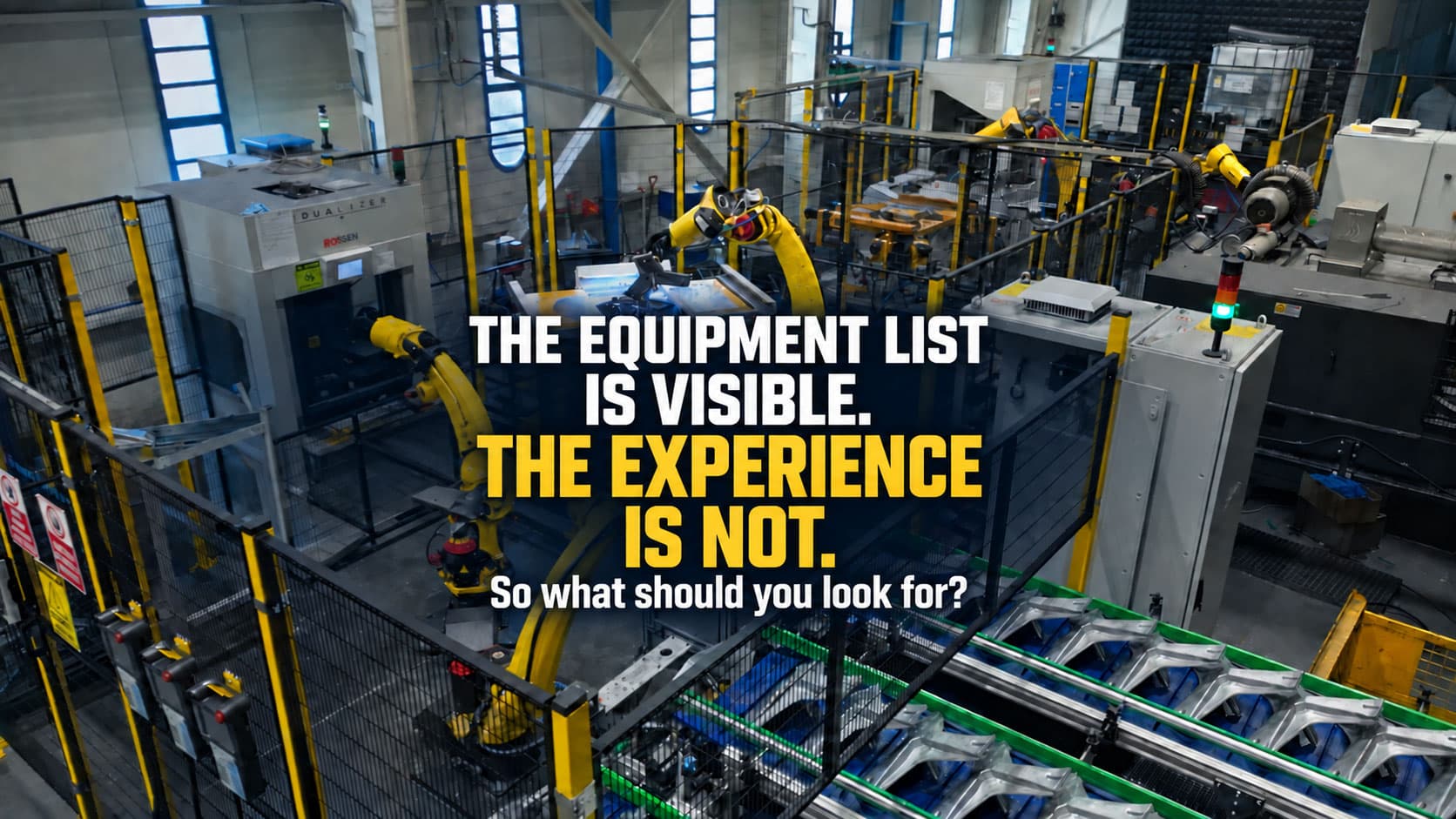
I wrote about evaluating an integrator before the order in Choosing a Robot Integrator: What Should You Look For?. This article starts where the decision has already been made.
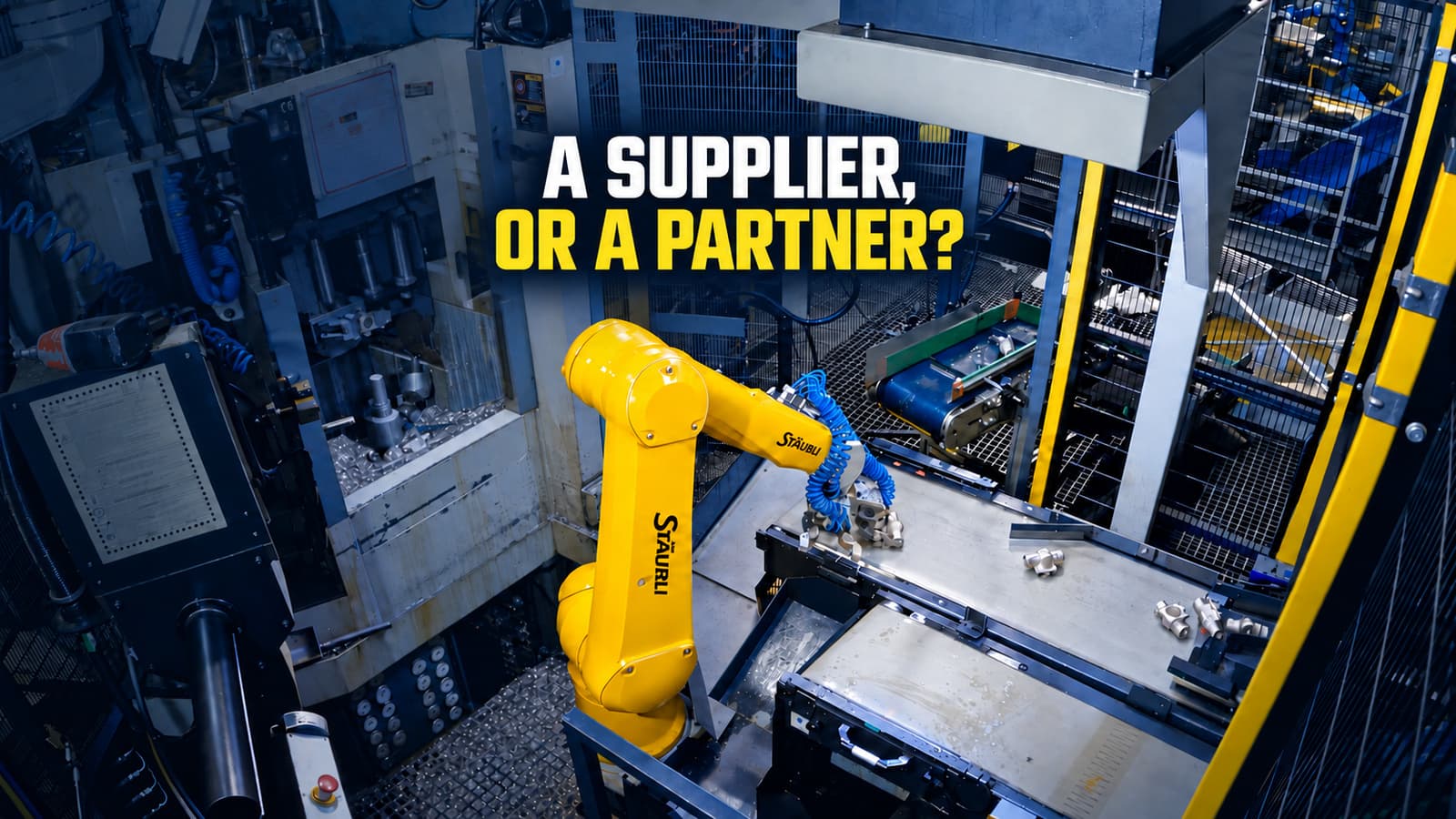
A Supplier, or a Partner?
A long-term relationship with an integrator matters for more than the system you are buying today. It shapes how your next automation decisions get made.
That relationship only works in both directions. It is not enough that you want to work with the company. The company has to see you as a long-term partner and want to work with you for years.
So how do you tell the difference? Most of it shows in ordinary project behavior — what happens when you ask for a cheaper component, who answers when the vision software needs a change, what the week after commissioning looks like.
Stage of the work | Selling one system | Building a partnership |
|---|---|---|
Before the order | Prices the request | Guides you on what your plant and your team need to be ready for |
Technical scope | Passes critical work to other firms | Keeps the work with its own engineers |
Under budget pressure | Replaces components as asked | Protects performance and safety, and accepts the risk of losing the order |
During the project | Reports when asked | Regular information flow, a test plan, notice at critical points |
After commissioning | Closes the project | Training, service, confidentiality, guidance on the next investment |
None of the behavior in the right-hand column appears in a quotation. It appears once the project is running.
The robotic cell shown in the video is one example of what a long-term automation partnership can produce.
We commissioned our first robotic transfer-machine feeding cell for TORUN Metal in 2014. TORUN Metal is a major metal manufacturer that has been ranked among Türkiye’s Top 500 Industrial Companies.
Transfer machines account for a significant part of the company’s production volume. Since that first installation, we have continued developing and commissioning high-speed, high-capacity robotic feeding solutions together. Today, Robsen robotic feeding cells serve 11 transfer machines at the facility.
For us, this is what a long-term automation partnership looks like: not simply repeating the same project, but continuing to develop the right solutions as production volumes, processes and requirements evolve.
Who Is Actually Doing the Work?
One of the more useful questions to ask is how much of the project the integrator will carry out with its own engineering team.
Some integrators outsource the critical engineering packages behind the systems they sell. The proposal may come from one company, while the machine-vision software, PLC programming, electrical design or pneumatic engineering comes from several others.
That arrangement may appear to work while the system is being built. It becomes more difficult after handover, when the production process changes or the cell requires service. A relatively small modification can turn into identifying which supplier developed each part of the system and waiting for a company with which you have no direct working relationship.
Machine vision is one of the clearest examples. When the integrator develops its own vision software, introducing a new part or revising an inspection tolerance remains a conversation with the engineers who designed the original cell. You do not need to reopen the system with a new software supplier each time your production requirements change.
At Robsen, we keep the project’s value-critical engineering within our own team. This includes:
- Mechanical design
- Automation and robotic engineering
- Robot and PLC programming
- Machine-vision software
- Electrical and pneumatic engineering
- Installation and commissioning
- Service, maintenance and troubleshooting
- Operator and engineering training
This does not mean that every physical manufacturing operation takes place inside Robsen. We work with specialist suppliers for mechanical fabrication activities such as sheet-metal cutting, welding, painting, large structural assemblies and certain CNC machining operations.
We make this distinction deliberately. Our objective is not to bring every fabrication process in-house simply to reduce the initial manufacturing cost. Our priority is to retain and continuously develop the engineering knowledge that determines how the robotic cell operates, how it can be diagnosed and modified, and how it can support future production requirements.
Keeping this knowledge within our team improves more than the first project. It strengthens our ability to identify faults, carry out revisions, provide service and training, introduce new parts and make better technical decisions in follow-up projects.
Before placing an order, it is worth asking:
- Which parts of this system will your own engineers design and program?
- Who owns and supports the machine-vision software and control code after handover?
- If we introduce a new part in two years, who will implement the change?
- Will we work with the same engineering team during commissioning, service and future modifications?
When the Budget Gets Tight
A robotic system is built from hundreds of components — the robot, the PLC, the drives, the industrial PCs, the panel equipment, the sensors. Every one of them has to work in agreement with the others, and the system runs safely and productively only when the equipment is good enough to allow it.
This usually gets tested during the budget conversation.
Say you want to go ahead, the proposed budget is higher than you planned, and you ask for some components to be replaced with cheaper alternatives. The request is yours. A professional integrator will still not give up the components that carry the performance and the safety of the system.
That is an integrator accepting the risk of not making the sale, in order to protect machine safety, operator safety and process safety.
The purpose is not to close the project. It is for the machine to run without trouble for years, and for your plant to stay safe while it does.
Safety Starts on the First Day of Design
Machine safety is not only a question of component quality.
It is a discipline that has to be carried through every stage: from the first day of design, through manufacturing and commissioning, and into the training the operators receive. Taking machine, production and operator safety into account at each of those stages, and running the risk analysis each stage calls for, is an expertise of its own.
This is where the number of projects behind an integrator becomes something other than a sales figure. An engineer who has delivered hundreds of cells has seen how they are actually used — including the moments the drawing does not show — and analyzes the hazards with that in mind before choosing the measures.
Leading the project and steering the customer correctly is part of the work, not an extra service on top of it.
The Schedule, the Tests and the Changes
An experienced integrator gives you a clear schedule and then works to it.
The schedule is informative before the project even starts. A supplier who can hand you a precise project plan is showing you that they command the whole process and have thought each stage through in detail.
Once the work begins, you should be getting a regular flow of information. Tests are run at each stage against a defined test plan, and the results are reported to you.
Changes will come. A robotic cell is designed specifically for your process, which makes some change along the way unavoidable. What matters is how it is handled. An experienced integrator manages those changes professionally, keeps the risk to both sides as low as it can be, and tells you when a decision point has been reached.
Feedback runs in both directions, and often. That frequency is what keeps the process under control at every step rather than at the two moments when a payment is due.
What to ask for during the project | What it tells you |
|---|---|
A project plan with dates per stage | Whether the integrator commands the process or is discovering it |
The test plan, and the results of each test | Whether progress is being measured or described |
A record of each change and what it affected | Whether changes are being managed or absorbed quietly |
Scheduled feedback in both directions | Whether you will hear about a problem early or late |
The People Who Will Run the Cell
Training and after-sales support decide what the investment is worth after the first month.
An integrator that intends to improve your operational efficiency provides training after the sale, and stays available when you need it.
There is a second part to this, and it is easy to underestimate on a first investment. A robot changes how the work is organized on the floor. Operators, maintenance and production planning all adjust, and the first reaction from the team is often a cautious one.
So the integrator’s service, installation and training people should be talking to your employees directly, not only to your project manager. A cell the team has taken ownership of is a cell that keeps running.
When your team adopts the investment, the success of the projects that follow multiplies.
What You Share During the Project
A robot project puts your process in front of another company’s engineers. Drawings, part geometry, cycle times, volumes, sometimes the products themselves.
An integrator planning a long relationship treats that material carefully and makes sure the whole team does — the information, the samples and the documents exchanged during the project.
It is an easy thing to check early and a difficult thing to repair later. How a company handles confidentiality is a fair indication of how seriously it takes the years ahead.
The Conversation About Your Next Investment
Robotics and production technology move quickly. An integrator who already knows your processes is in a position to look at them and tell you where the next investment would do the most good.
That guidance is usually given free, as a matter of good faith. It is also one of the clearest signals of intent. A company that wants a single order has little reason to spend engineering hours on the order after it.
For a manufacturer with a limited investment budget, this is practical rather than sentimental. It is what puts the money where it produces the most.
Six Months In
By the time the cell is running you will have watched your integrator handle a schedule, a budget conversation, a test result and a change request.
Those four moments tell you more than a reference list can.
So the question worth asking, six months in, is a simple one: is this still the company that came to your factory and asked the questions you had not thought of?
Planning your first robot cell and not sure what your plant needs to have ready? Send the part drawings and a short description of the process to ferhadkaleli@robsen.com.tr, and we will go through the preparation with you — what we need from you, and what we take on.