

Table of Contents
- In This Article
- A Robot Cell Is Not a Catalogue Product
- What Production Information Can Change
- One Missing Number Can Change the Payback from Years to Decades
- A Simple Part Can Create a False Sense of Simplicity
- A Practical Starting Point: Manual Task Mapping
- Download the Fillable IROCUBE Manual Task Mapping Form
- Better Information Creates a More Reliable Quotation
In This Article
- Why a quick budgetary price must be supported by clearly stated assumptions.
- How one missing production detail turned an automation payback calculation into approximately 40 years.
- Why a simple part produced today may require a different handling system tomorrow.
- How Manual Task Mapping helps manufacturers and integrators define a realistic robotic cell.
- How Robsen adapted the Lean Robotics methodology for IROCUBE project assessments.
- A fillable IROCUBE assessment form you can use before requesting a quotation.
“How quickly can you send us a price?”
This is often one of the first questions we hear during a robotic automation discussion.
The manufacturer may provide a part drawing, the CNC machine model and an annual production quantity. Sometimes the initial description consists of only a few sentences:
“We have been producing this part for three years.”
“Our order book is full for the next year.”
“The part is simple.”
“We only need the robot to load and unload it.”
That information may be sufficient for an initial conversation. It is not always sufficient for a reliable robotic cell quotation.
A fast budgetary range can still be useful, provided that the assumptions behind it are clearly visible. But when those assumptions are treated as confirmed production data, both the technical concept and the payback calculation can quickly become misleading.
A Robot Cell Is Not a Catalogue Product
A robotic investment may have a purchase value comparable to a premium vehicle. The purchasing process, however, is completely different.
A vehicle has already been engineered before the customer enters the showroom. Its engine options, dimensions, safety systems and optional features have already been defined.
A robotic cell is configured around the customer’s actual production process.
The part drawing is only one input. The integrator must also understand:
- How the part arrives
- How it is oriented
- How the operator handles it
- How frequently the task is performed
- How the part is clamped
- How the machine door operates
- What happens before and after machining
- How changeovers are completed
- Which information the operator reads or enters
- What the cell is expected to provide to the next operation
- Which new part families may enter production later
Each answer can change the robot, gripper, feeding method, vision system, controls, safety architecture, cycle time and commercial scope.
What Production Information Can Change
Production information | What it can change |
|---|---|
Actual manual cycle and operating hours | Labor exposure, required robot speed and payback |
Part dimensions, weight and surface | Robot payload, gripper and handling method |
Input presentation and packaging | Conveyor, feeder, tray handling or bin-picking requirement |
Current and future part families | Gripper range, recipes, vision and changeover strategy |
Machine door and clamping system | Mechanical modifications and machine interface |
Work orders, labels and recipes | PLC, HMI, barcode and ERP/MES integration |
Existing layout and access areas | Robot reach, footprint, guarding and service access |
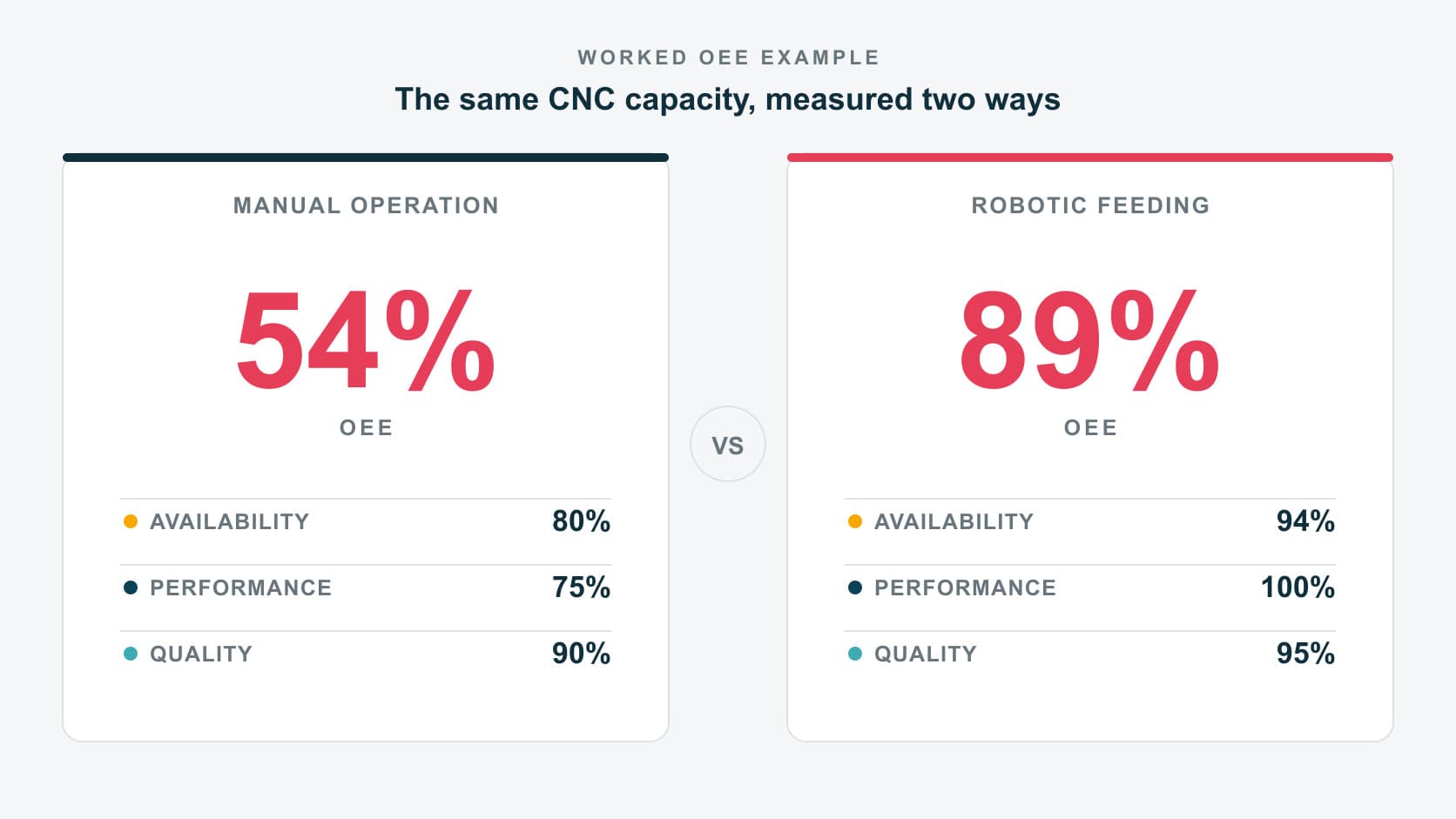
Current KPIs | Acceptance criteria and expected production efficiency |
The questions are not administrative work added before engineering begins.
They are part of the engineering.
One Missing Number Can Change the Payback from Years to Decades
We learned this through a project we evaluated for a manufacturer of zipper components.
The customer wanted to automate a counting operation. An operator would take components from a large container, spread them onto a tray and count the required quantity for each order.
For the operator, this was a remarkably quick task. Years of experience and human dexterity made it possible to take a handful of components, separate them rapidly and count them at a speed that was difficult to appreciate without watching the process directly.
At the beginning of the study, the production quantity appeared large enough to justify automation. A cycle target of approximately 2.5 seconds per component was discussed, and we began evaluating robotic feeding, separation and counting concepts.
This particular application could not be reduced to a straightforward weighing or machine-vision counting system. Automating it would require a combination of feeding, separation, transportation, sensing and robotic handling equipment.
After considerable engineering work, we established one critical fact more clearly: the complete daily quantity was being counted by a single operator in approximately 2.5 to 3 hours.
Our early evaluation had not represented the actual labor exposure accurately enough. The early concept had been approached as though the demand would occupy a system for much longer periods, while the existing task required only part of one person’s working day.
Once the real operating time was included, the estimated payback period approached 40 years.
The project was not feasible.
The lesson was not that the technology had failed. The lesson was that one missing production fact had changed the entire business case.
A cycle-time target is not a business case. You must also know how often the cycle occurs and how much labor the task actually consumes.
Before calculating robotic payback, we need to know more than the number of parts:
- How many operators currently perform the task?
- How many hours per shift are they actively occupied by it?
- How many shifts run the process?
- Is the operation continuous or completed in short batches?
- What does the operator do during the rest of the shift?
- What is the actual cost of counting or quality errors?
- Will the automated system create capacity that can be used elsewhere?
In hindsight, we should have established these answers earlier.
That experience changed how we evaluate similar opportunities. Even a technically possible project may not be a commercially sensible investment when the real manual workload is misunderstood.
A Simple Part Can Create a False Sense of Simplicity
Consider a different machine-tending opportunity.
A customer has a high-volume cylindrical component. The order book is full for the coming year, and the same part has been in production for three years. The component can be loaded into a vertical machining center without first determining a specific angular orientation.
The initial robotic concept may appear unusually simple:
- Pick the component
- Load the fixture
- Start the machining cycle
- Unload the finished part
- Repeat
The customer may reasonably ask for a quick price based on that production scenario.
But two conditions in this example are less common than they first appear.
The first is a machining operation that can continue with one fixed part for several years. Many manufacturers now operate with greater product variety, shorter order periods and more frequent changeovers.
The second is a cylindrical component that can be loaded into a vertical machining center without an orientation check.
Angular orientation is often less critical in conventional lathe-tending applications. In vertical machining centers, however, holes, flats, keyways, asymmetric surfaces and fixture details frequently require the part to arrive in a known orientation.
The current part may not require a vision-guided orientation station.
The next part might.
An industrial robot can remain economically useful for many years—sometimes 15 to 20 years—depending on its duty cycle, maintenance and future deployment.
The production order used to justify the first investment may last only one, three or five years.
What happens if the current order ends and the next component requires orientation?
A future orientation station could require:
- Controlled lighting
- One or more cameras
- A defined inspection background
- Additional part-presence sensors
- A rotating or indexing mechanism
- More space around the feeding area
- Additional PLC inputs and outputs
- New robot positions and trajectories
- Changes to guarding and the safety concept
- New software recipes and calibration procedures
For large or heavy cylindrical parts, simply adding a camera may not be enough. The component may need to be rotated under controlled conditions so that the vision system can locate a specific feature.
The customer does not necessarily need to purchase this complete station today.
It may still need to be considered today.
The initial design can reserve the required footprint, robot reach, controller capacity, electrical connections, software interfaces and safety access. These provisions can make a later expansion significantly easier.
Adding a station while the system is still being assembled at Robsen is usually different from retrofitting it after installation. Work performed later at the customer’s plant can introduce travel, service, production interruption, recommissioning and renewed safety-validation costs.
Future-ready does not mean purchasing every possible option today. It means avoiding an architecture that makes tomorrow’s option unnecessarily expensive.
This distinction also helps us explain the quotation more clearly. We can separate:
- What must be installed in Phase One
- What should be prepared in the initial architecture
- What can be added when a future requirement becomes real
That is more useful than either ignoring the future or including every possible option in the first investment.
A Practical Starting Point: Manual Task Mapping
Collecting this information does not need to become another engineering project.
To make the first assessment easier, we adapted the Manual Task Mapping approach from the Lean Robotics methodology developed by Robotiq and expanded it for IROCUBE machine-tending projects.
The fillable form helps manufacturers summarize the current manual process, actual operating times, part presentation, machine interfaces, layout and possible future part variations before requesting a robotic cell quotation.
It is not an exam, and every answer does not need to be perfect. Clearly identifying an unknown is far more useful than allowing an unverified assumption to become part of the concept.
The form may be less exciting than watching a robot simulation. It is usually much less expensive than reopening the complete concept later.
Download the Fillable IROCUBE Manual Task Mapping Form
The fillable IROCUBE Manual Task Mapping — Project Assessment can be completed digitally and supported with part photographs, a video of the current manual cycle, CAD files and machine information.
Better Information Creates a More Reliable Quotation
A good quotation is not simply the longest or most detailed document.
It is a quotation in which the technical scope, production assumptions and business case describe the same process.
Better information allows us to distinguish between:
- The equipment required today
- The provisions worth considering for tomorrow
- The options that do not yet require investment
- The assumptions that still need testing
- The production data that determines feasibility
The fastest route to a reliable robot quotation is not fewer questions. It is better information earlier.