

Table of Contents
- In this article
- Keep the comparison on the same basis
- Availability: from 80% to 94%
- Performance: a repeatable loading cycle
- Quality: reducing loading-related variation
- The robotic OEE calculation
- What the robot changes—and what it does not
- Designing the cell around the machine and the floor
- What a 60-IROCUBE installation shows
- The practical conclusion
In this article
- How robotic tending changes CNC availability within the same 500-minute time basis.
- Why repeatable loading can improve performance without changing the machining cycle.
- How sensors reduce loading-related quality variation while other process risks remain.
- What a 60-IROCUBE installation shows about operator workload, buffers and the manual tasks that remain.
Now we will keep the CNC machine, the part, the ideal machining rate and the 500-minute production period unchanged. The only variable we will change is the feeding method.
The question is no longer how OEE is calculated. It is which losses robotic tending can realistically reduce, why the result changes and which losses still remain after automation.
A robot does not improve OEE simply because it moves. It improves OEE when its repeatability keeps the production equipment available and supplied.
Keep the comparison on the same basis
The manual example used three measurements:
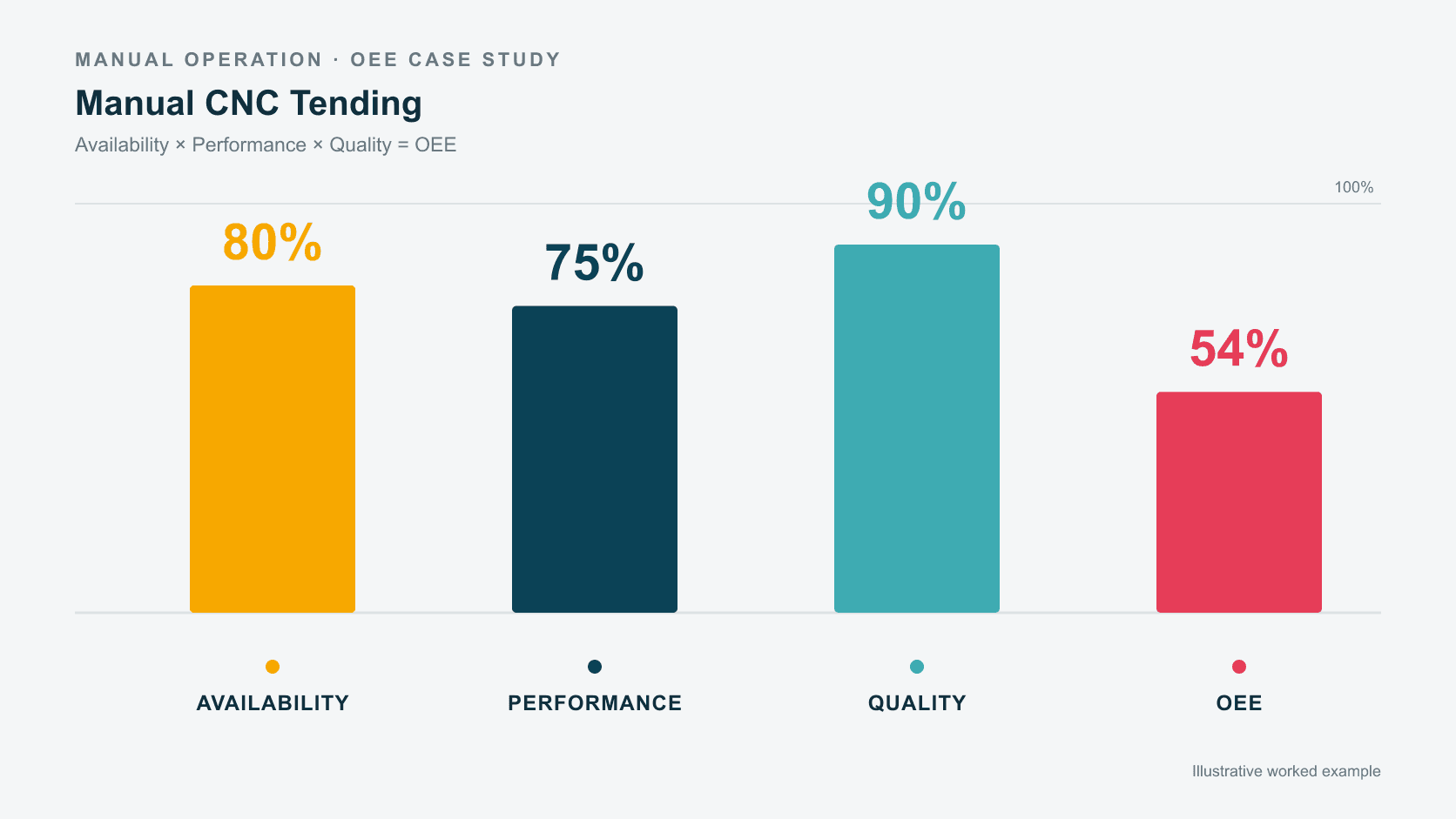
- 80% availability.
- 75% performance.
- 90% quality.
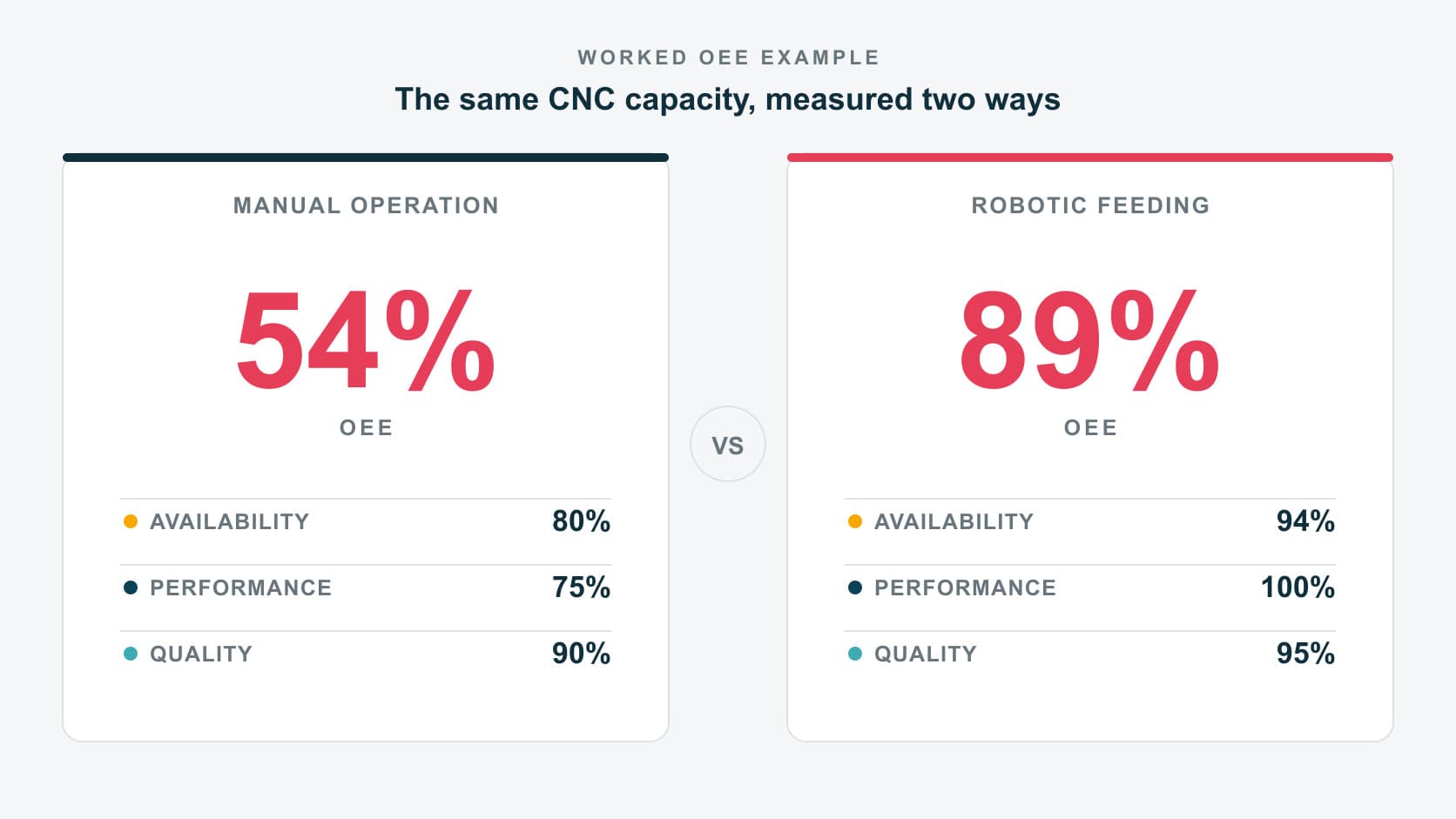
Together, they produced 54% OEE.
For the robotic scenario, the defined production period remains 500 minutes and the ideal production rate remains one part per minute. Holding those assumptions constant is essential. If the time basis, part or ideal cycle changes at the same time as the feeding method, it becomes difficult to identify what the robot actually changed.
Availability: from 80% to 94%
In the manual scenario, lunch, routine breaks, material handling, cleaning and lubrication reduced the available production time to 400 minutes.
In the robotic scenario described in the August column, the interruptions connected with the operator’s meal and personal breaks are removed from the machine-feeding process. Robot setup and cleaning require 30 minutes, leaving the CNC available for production for 470 of the 500 minutes.
Availability = 470 ÷ 500 = 94%
This does not mean that automation eliminates every form of downtime. The CNC machine may still require maintenance, tools may still wear or break and upstream material may still be unavailable. The improvement in this example comes from reducing the losses associated with manual feeding and organizing the cell so that the machine can remain supplied.
The source also describes successful applications in which an air gun mounted on the robot cleans the machine interior between cycles. Where the process permits that approach, availability has reached as high as 96%. That field result is not used in the 89% calculation below; the worked example remains at 94% availability.
Performance: a repeatable loading cycle
Performance is where robotic feeding creates the clearest difference in this example.
The robot follows a trajectory developed for the part and the machine. Once the loading sequence has been optimized, the same movement is repeated at the same points and with the same timing on every cycle. The robot does not need to walk between machines, and its loading rhythm does not change with fatigue or distraction.
Across the 470 available minutes, the ideal rate remains one part per minute. The scenario assumes that 470 parts are produced.
Performance = 470 ÷ 470 possible parts = 100%
The 100% figure belongs to this worked example; it should not be treated as a guarantee for every robotic cell. Actual performance still depends on the robot program, gripper, part presentation, machine interface and the stability of the wider process.
The point is also not that the robot shortens the CNC machine’s machining cycle. In this scenario, it improves performance by making the loading cycle consistent and preventing the machine from waiting unnecessarily for the next part.
Quality: reducing loading-related variation
Repeatable loading can also reduce errors caused by variation at the machine door.
Sensors can confirm that a part has been positioned correctly before the machining cycle begins. If the expected position is not verified, the cell can stop before the CNC starts machining. Depending on the application, downstream test equipment can also be integrated into the robotic cell. The source gives a leak-test station as one example of how finished parts can be checked against the required specification.
Automation does not eliminate every source of rejected parts. Tool wear, machining problems and demanding test limits can still produce nonconforming parts. In the August example, approximately 20 parts from a 470-part shift are treated as rejected, and the quality input is conservatively represented as approximately 95% for the OEE calculation.
Quality ≈ 95%
These are illustrative, rounded values taken from the source example, not a universal quality promise for robotic tending.
The robotic OEE calculation
OEE factor | Manual scenario | Robotic scenario |
|---|---|---|
Availability | 400 ÷ 500 = 80% | 470 ÷ 500 = 94% |
Performance | 300 ÷ 400 = 75% | 470 ÷ 470 = 100% |
Quality | 270 ÷ 300 = 90% | Approximately 95% |
OEE | 80% × 75% × 90% = 54% | 94% × 100% × 95% ≈ 89% |
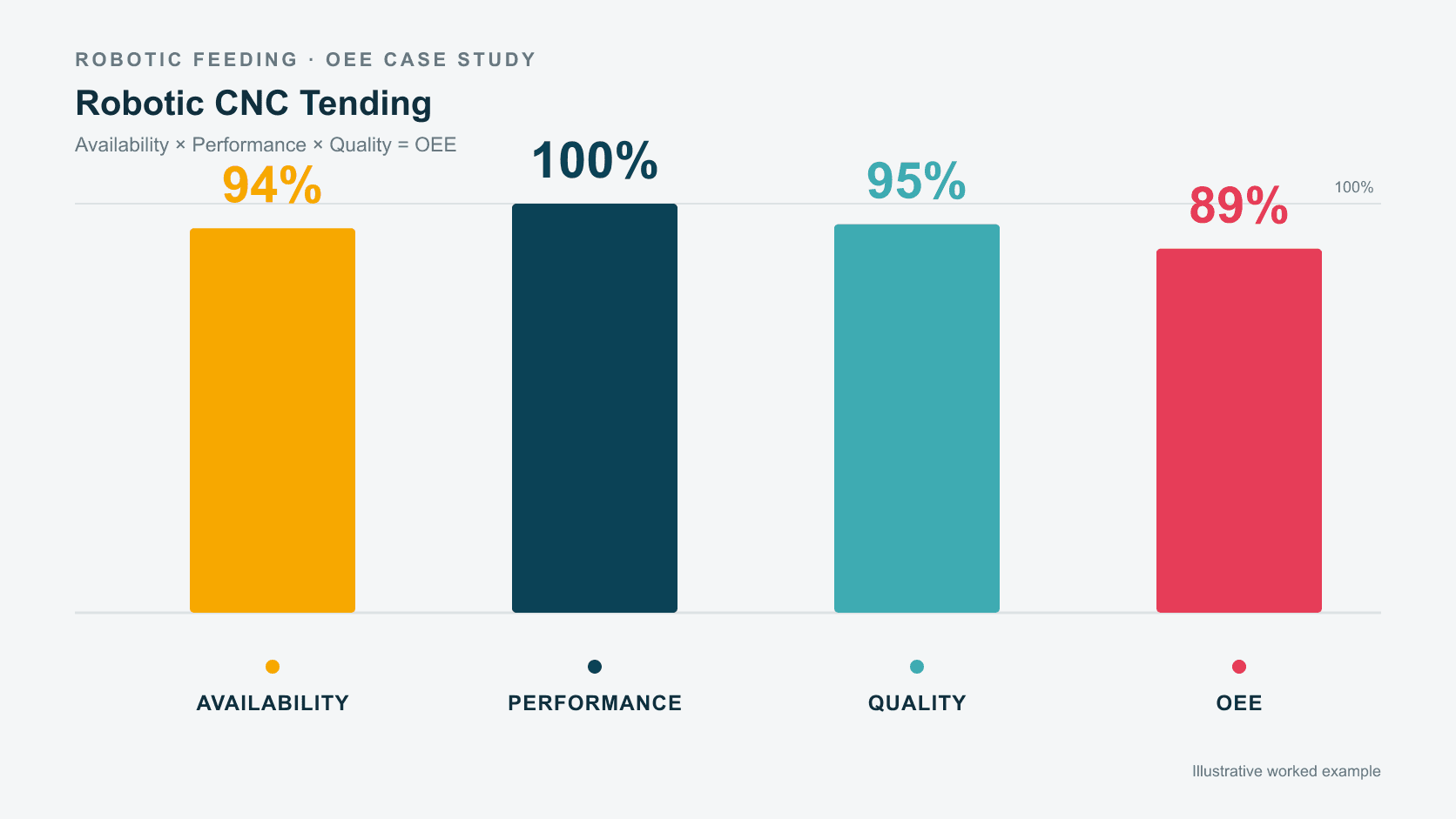
Using the rounded values in the source, robotic feeding increases OEE from approximately 54% to approximately 89%—a difference of about 35 percentage points on the same defined time basis.
The important point is not the headline number alone. The calculation shows where the difference comes from:
- More of the defined time remains available for production.
- The loading cycle becomes repeatable.
- Loading-related quality variation is reduced.
What the robot changes—and what it does not
The robot supports the production process; it does not replace the need to understand it.
It can keep the CNC supplied consistently. It can repeat the same loading sequence. Sensors can verify that the part is positioned before machining begins. Additional testing can be integrated where the application requires it.
But the robot cannot compensate for every weakness elsewhere in the process. Tool life, machining parameters, material supply, maintenance and downstream constraints must still be managed. If those losses dominate the OEE result, installing a robot at the machine door will not automatically recover them.
This is why the manual baseline in the first article matters. Without knowing where the original losses occurred, the improvement cannot be attributed honestly.
Designing the cell around the machine and the floor
The source also connects OEE improvement with the physical design of the robotic cell.
The IROCUBE MF Series was developed for Fanuc Robodrill machining centers. Its front-facing arrangement allows multiple cells to be positioned side by side while preserving access from the front. This layout is intended to use less floor space than comparable arrangements that require access or equipment around several sides of the CNC machine.
Floor space matters because a capacity strategy should not solve one constraint by creating another. Recovering output from the installed machine park can be more valuable than adding equipment that requires further expansion of the production area.
What a 60-IROCUBE installation shows
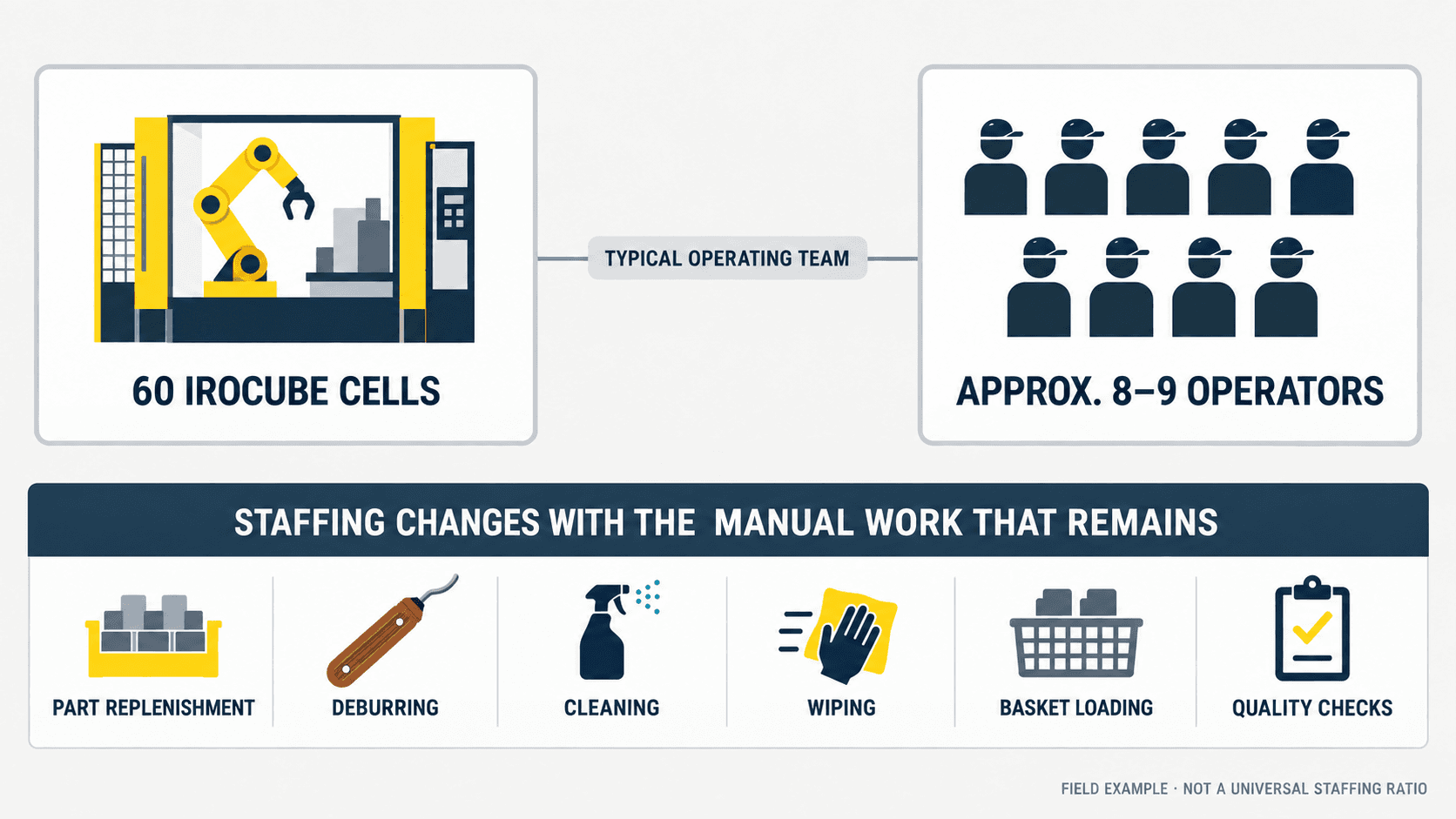
One of our customers operates a production installation containing approximately 60 IROCUBE cells. Around eight to nine operators work across this installation.
That number is not determined by the robot count alone. It rises or falls according to the additional manual responsibilities assigned to the operators around the cells. These may include replenishing parts, deburring, cleaning the equipment, wiping parts, arranging finished components in baskets and performing quality checks.
Installation detail | Observed arrangement |
|---|---|
Installed robotic cells | Approximately 60 IROCUBE cells |
Typical operating team | Approximately 8–9 operators |
Additional tasks affecting staffing | Part replenishment, deburring, cleaning, wiping, basket loading and quality checks |
Planning lesson | Operator requirements must be calculated from the complete remaining workload, not from the robot count alone |
The conveyor buffer is an important part of this operating model. By storing enough in-process parts, it gives operators time to move between cells without allowing the CNC machines to wait immediately for replenishment. But buffer capacity cannot remove every manual duty. If an operator is also expected to deburr, clean, inspect or arrange parts, fewer cells can be covered reliably.
Operator coverage is determined by the work left around the robot—not by the robot count alone.
For that reason, “How many robots can one operator manage?” does not have a fixed answer. The more useful question is: “After automation, which manual tasks remain, how frequently must they be performed and how much operator time do they require?”
The practical conclusion
The movement from 54% to 89% is not evidence that every CNC operation will achieve the same result after robotic tending. It is a worked example showing how OEE helps separate different kinds of production loss.
The manual calculation establishes the baseline. The robotic calculation shows which losses can change when part feeding becomes consistent. The remaining losses show where further process work is still required.
The value of robotic tending is not that the robot stays busy. It is that the production equipment spends more of its available time producing acceptable parts.
That recovered production time is also connected to the wider cost of stops and underused capacity. We examine that subject separately in The Real Cost of Downtime in Manufacturing.
Would you like to understand which part of your CNC OEE could realistically be improved through robotic tending? Talk to us about an assessment based on your actual shift and production data.