

Table of Contents
In this article
- Why a running CNC machine is not necessarily a fully utilized machine.
- How availability, performance and quality combine to determine OEE.
- A worked OEE calculation for a manually tended CNC machining center.
- Why reliable OEE data should come before another shift, more floor space or a new machine.
Walk through a CNC shop and you will see machines running, operators moving between stations and finished parts accumulating beside the line. Production is active—but activity alone does not prove that the available capacity is being used fully.
That distinction matters most when a manufacturer believes the existing machine park has reached its limit. The next decision may be to add a shift, expand the production area or purchase another CNC machine. Before making any of those investments, however, one question should be answered with data:
Are your machines genuinely at full capacity, or do they only appear busy?
In an earlier article about missing production data, I discussed why manufacturers can struggle to prove the capacity they already have. OEE—Overall Equipment Effectiveness—is one of the measurements that can turn that uncertainty into a number.
What OEE actually measures
OEE expresses how effectively a machine, production line or independent station is being used. It combines three separate factors:
- Availability: How much of the defined production time was the equipment available to run?
- Performance: During that available time, how closely did output match the ideal production rate?
- Quality: How many of the produced parts met the required specification?
OEE = Availability × Performance × Quality
A theoretical OEE of 100% would mean that the equipment ran throughout the entire defined production period, at its ideal rate, without producing a defective part. Actual production is more complicated. Stops, operator-dependent loading, material flow, cleaning, tool problems and rejected parts all reduce the result.
OEE is useful because it prevents these different losses from being hidden inside one general statement such as “the machine was running all day.”
Measure before choosing how to add capacity
The objective is not simply to keep equipment occupied. It is to use the capacity already installed in the factory effectively and then increase it through the right investment.
Consider a production area with ten CNC machines. If more output is required, management may see three possible paths.
Add another shift
An additional shift can increase available production hours, but it also requires people, supervision and changes to the existing organization.
Add more CNC machines
New machines add capacity directly, but this is generally the highest-investment option. They also require floor space, utilities, tooling and the people or automation needed to operate them.
Recover capacity through robotic tending
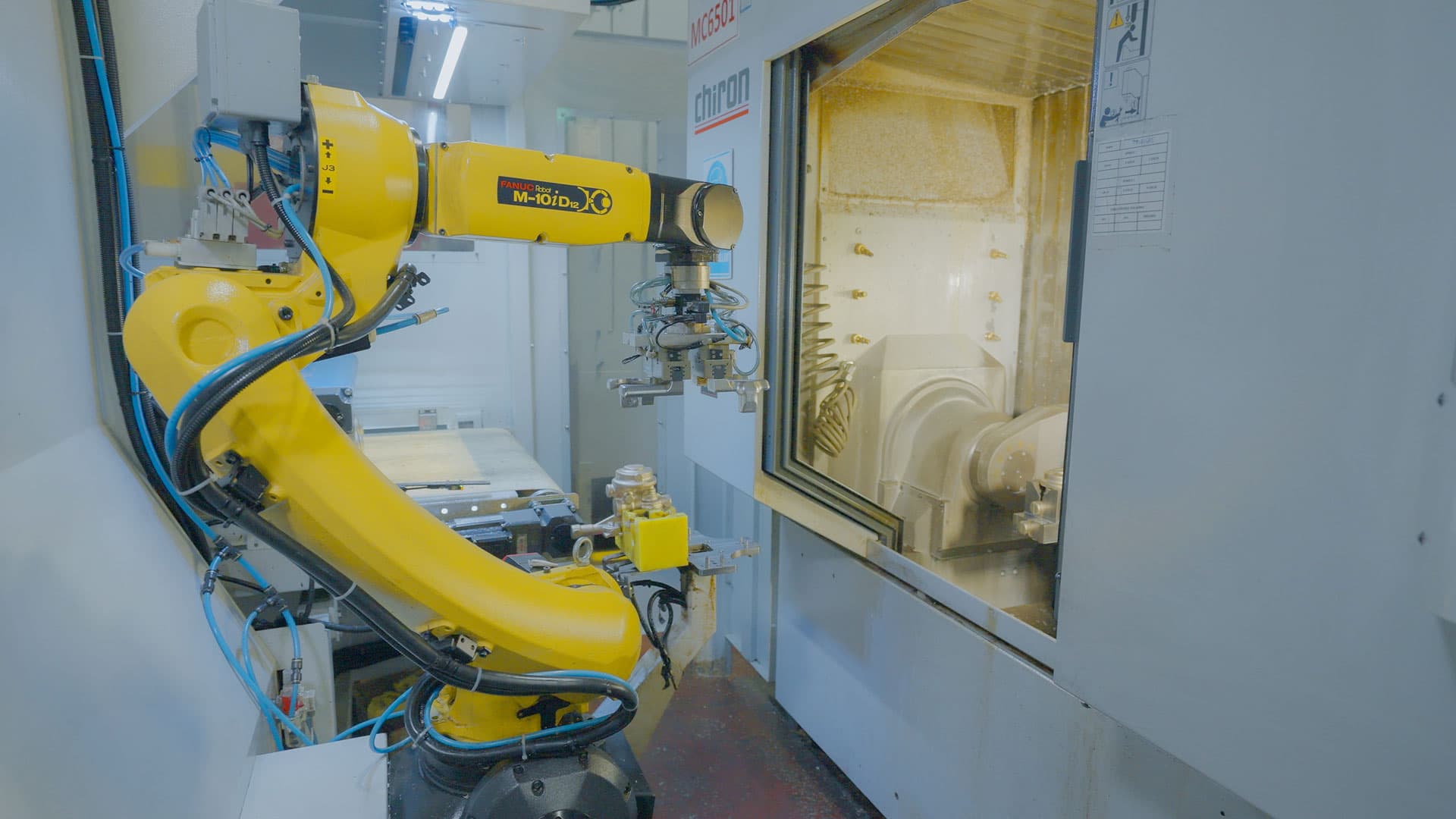
If the existing machines still contain recoverable capacity, robotic machine tending may increase output with a smaller footprint and lower investment than purchasing another CNC machine.
But automation should not be selected on assumption alone. The OEE data must first show where the losses occur and whether loading is one of the constraints. Otherwise, a manufacturer may automate the wrong part of the process—or purchase capacity that was already available but not being used.
A worked example: manually tended CNC machining
A reliable OEE study normally requires production data collected over a meaningful period. To make the calculation easy to follow, the following example uses a single manually tended CNC machining center and a 500-minute production period.
This is an illustrative calculation based on the August column. It is not presented as a universal benchmark for every CNC operation.
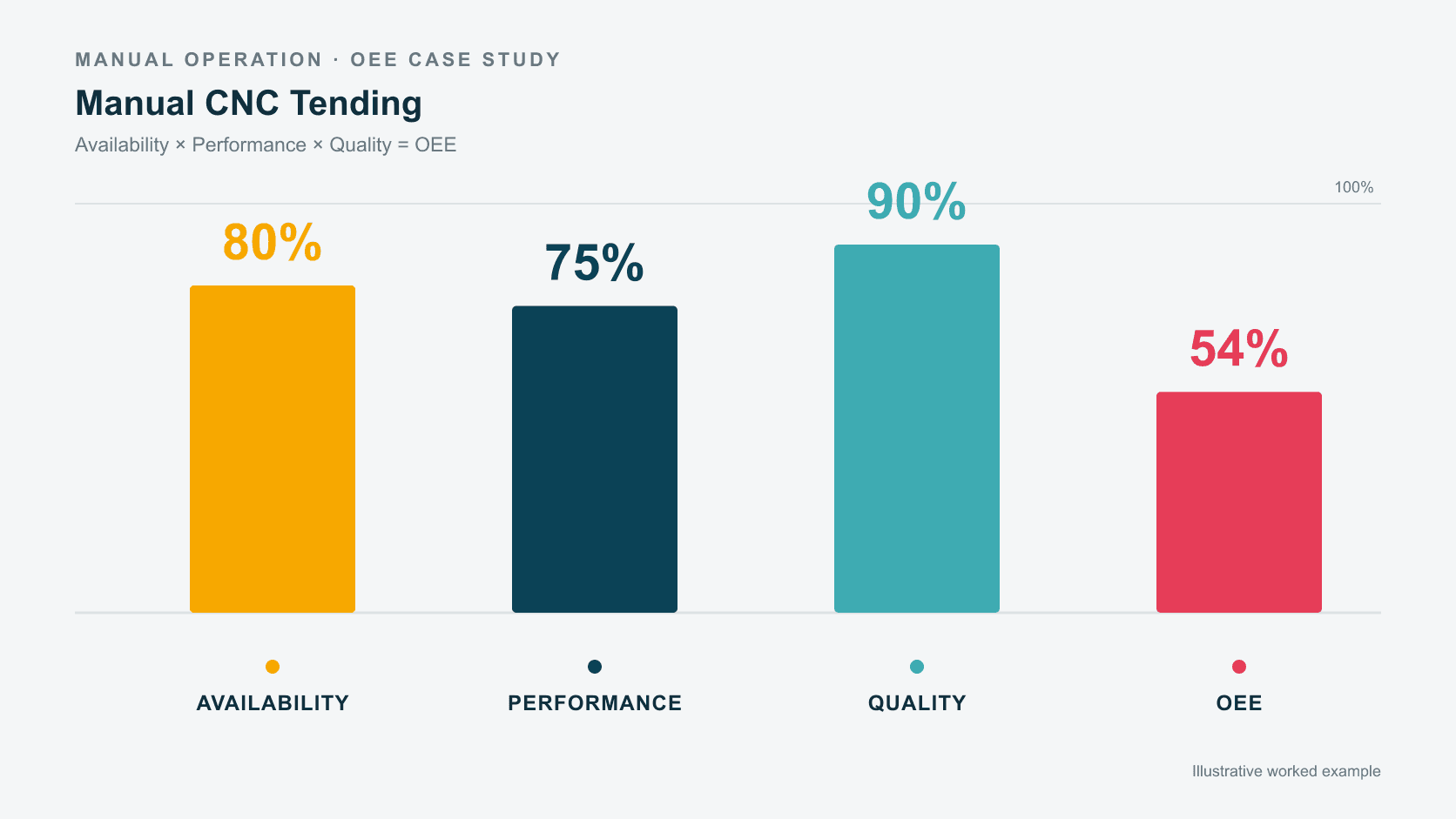
Availability: 80%
The defined production period is 500 minutes.
During that period, the example includes:
- 40 minutes for lunch.
- 20 minutes for routine personal breaks.
- 40 minutes for material supply, machine cleaning and lubrication.
These losses total 100 minutes, leaving 400 available production minutes.
Availability = 400 ÷ 500 = 80%
The time basis must always be defined consistently. In a formal OEE system, periods in which production is not scheduled may be excluded from Planned Production Time instead of being counted as availability losses. In this worked comparison, the complete 500-minute period is used deliberately so that the manual and robotic scenarios can later be evaluated on the same basis.
Performance: 75%
Assume the ideal machining rate is one part per minute. Across 400 available minutes, the theoretical output is therefore 400 parts.
Manual loading performance can change during a shift. The operator may need to manage material, move between machines or respond to other production requirements. Fatigue and attention can also affect the consistency of loading.
In this example, actual output is 300 parts rather than the theoretical 400.
Performance = 300 ÷ 400 = 75%
Quality: 90%
Quality measures the proportion of good parts within the total output.
Assume that 30 of the 300 produced parts are rejected following an incorrect feed into the machine. The shift therefore produces 270 acceptable parts.
Quality = 270 ÷ 300 = 90%
The resulting OEE: 54%
OEE factor | Calculation | Result |
|---|---|---|
Availability | 400 ÷ 500 minutes | 80% |
Performance | 300 ÷ 400 possible parts | 75% |
Quality | 270 ÷ 300 produced parts | 90% |
OEE | 80% × 75% × 90% | 54% |
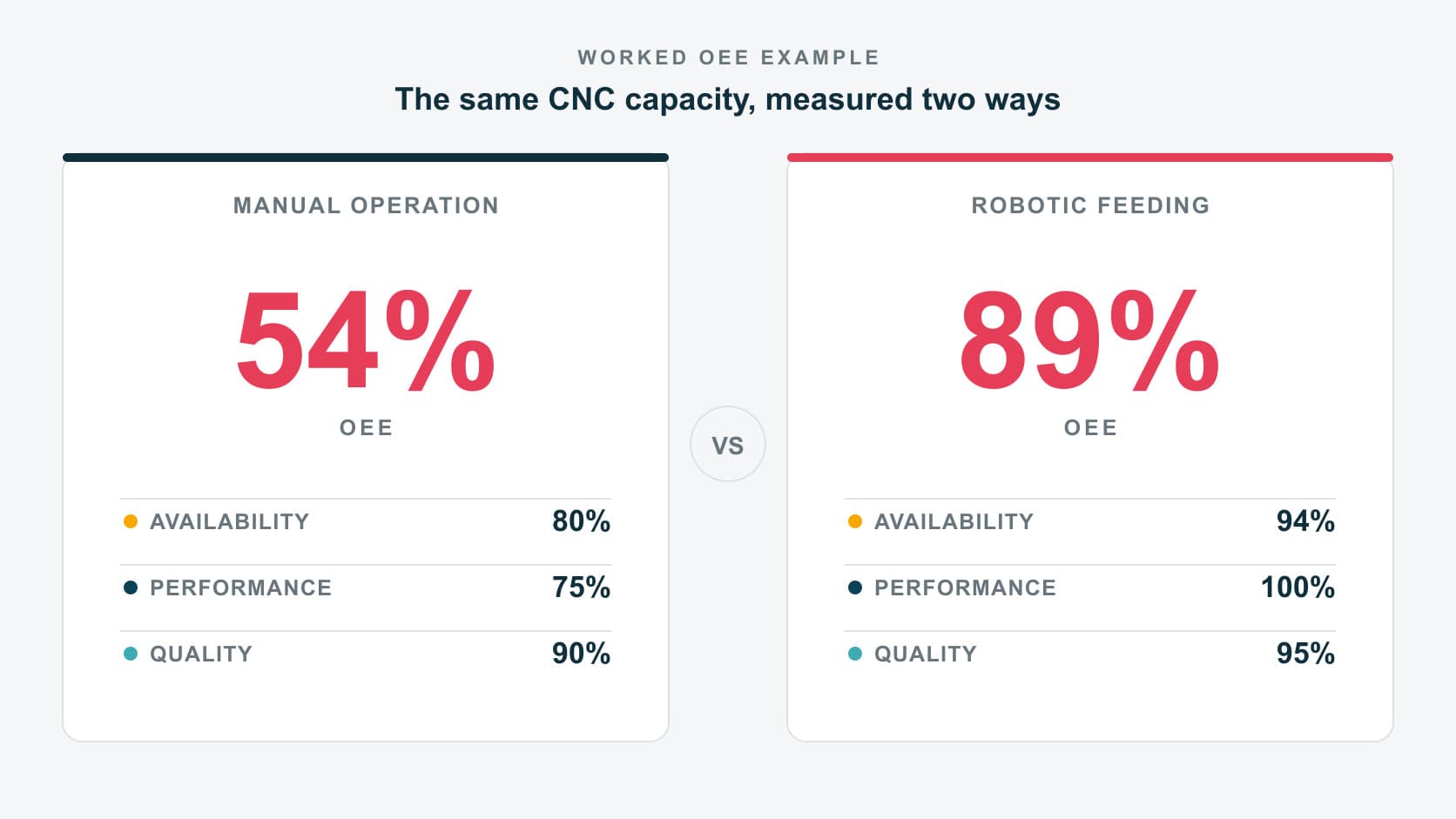
The CNC machine may have appeared active throughout the shift. The operator may also have remained busy. Yet when availability, performance and quality are evaluated together, the effective result in this example is 54%.
What the 54% result tells you
The purpose of this example is not to claim that every manually tended CNC machine operates at 54% OEE. A plant with different break arrangements, material flow, cycle times, staffing or quality performance will produce a different result.
The important lesson is that visible activity and measured effectiveness are not the same thing.
Even a well-managed production process can experience tool breakage, material-supply interruptions, workplace incidents or delays involving replacement parts. In many factories, one operator is also expected to tend several machines. Even without considering the walking distance between them, keeping every machine continuously supplied is difficult.
If these losses are not measured over time, management may conclude that the machine park is insufficient when the real issue is that part of the installed capacity is being lost inside the process.
A machine that is running is not necessarily a machine whose full capacity is being used.
What comes next
A 54% OEE result does not automatically tell you to purchase another machine—or to install a robot. It tells you where the investigation should begin.
The next question is which of these losses robotic tending can realistically reduce, which losses remain part of the machining process and how the calculation changes when the CNC machine, the part and the 500-minute time basis stay the same but the feeding method changes.
Continue with: What Changes When a Robot Feeds the CNC?
Not sure whether your CNC lineup is genuinely at capacity or simply busy? Talk to us about evaluating your part mix and production data before committing to another machine investment.