

Table of Contents
In this article
- What planned and unplanned downtime include, from scheduled maintenance to tool breakage and unexpected component replacement.
- Why the cost of a stopped machine extends beyond lost output to delivery delays, penalties, reputation damage, and lost capacity.
- How the McKinsey 8–12% figure and the Siemens/Senseye downtime benchmarks should be interpreted without treating them as the same measurement.
- Why reliable production data is the starting point for improving maintenance decisions, evaluating MES records, and planning robotic automation.
One of our customers was operating CNC machining centers with manual part loading and unloading. Maintenance intervals were estimated from experience, but the plant was not recording the number of parts produced since the last service, the machine's operating hours, or the elapsed operating time since the last tool change.
The issue was not carelessness. The data required to verify those maintenance decisions was not available.
This example illustrates a broader downtime problem: manufacturers may know that production stopped, but without reliable operational records they cannot fully explain the cause, evaluate the cost, or identify the right corrective action.
What downtime is, and which half hurts
Downtime is any period in which a machine is not producing.
Planned interruptions, such as scheduled training, preventive maintenance, and planned tool changes, are known in advance and can be included in the production plan.
Unplanned downtime occurs when production stops unexpectedly. It may be caused by a machine failure, tool breakage, incorrect part loading, an unexpected maintenance or component-replacement requirement, a safety incident, or a repair that is extended because the required spare part is unavailable.
During these events, the machine stops creating value while operating and delivery-related costs continue.
The bill is bigger than the parts you didn't make
This is where the arithmetic gets away from people. The cost of stopping is not only the direct production loss. The total financial hit a company takes during these interruptions is bigger than it assumes.
Alongside the parts you didn't make there are indirect costs: reputation damage from late deliveries, and sometimes compensation you're obliged to pay because of them. These aren't rounding errors. They're expense lines that move profitability.
McKinsey's 2023 analysis found that indirect operations functions—including engineering, quality management, production management, maintenance, and supply chain—account for 8% to 12% of total operations cost. This is not a measure of downtime alone. It shows why the financial consequences of a stop often extend far beyond the value of the parts that were not produced.
And those consequences are the hardest ones to see, which is the whole problem. I'll come back to that.
An hour of downtime is not what it was
Siemens has been measuring this since 2019, and the direction has not changed. When I first wrote about their findings, an hour of unplanned downtime already cost manufacturers at least 50% more than it had two years earlier. Rising inflation on one side, production lines running at higher capacity on the other.
The latest edition says the curve never flattened.
Siemens / Senseye · The True Cost of Downtime 2024:
- 11% of annual revenue — what unplanned downtime costs the world's 500 largest companies, $1.4 trillion between them
- 2x in automotive, 4x in heavy industry — what an hour of downtime costs against its 2019 level
- $253 million a year — the cost of downtime at an average large plant across the sectors surveyed
Two of those numbers describe companies far bigger than most of the shops I walk into. The middle one doesn't care how big you are. Whatever an hour costs you, it costs a multiple of what it cost in 2019.
When did you last recalculate it?
Three fixes, and the order matters
To manage the cost of downtime and bring it to a minimum, the first thing is a healthy and continuous flow of data. That is the non-negotiable condition for developing a strategy at all. It's also the first stage for every other measure and decision — because without reliable data in hand, how is a business supposed to plan the stages that follow?
Second, you have to consider the production process as a whole and develop solutions with broader approaches. Manufacturing execution software (MES) and better preventive maintenance practices are steps you can take here.
Third, the case for investing in advanced technology in production isn't in dispute. Robotic automation systems and other innovative technologies make production processes more flexible and more efficient.
Now read those three again, and don't read them as a list. These solutions follow one another, support one another, and work together. Treating them as independent steps is the mistake. They have to be handled as a whole and integrated.
A stop duration shows how long production was interrupted. Reliable data connects that time to its cause, production loss, and business impact.
What we've watched happen
I've worked closely with the metal industry for nearly fifteen years. For more than ten of those I've been developing robotic systems for companies in this sector with the Robsen team. Many times we've led a customer through the first robot investment on their production line.
That gave us something unusual: the chance to analyze, over years, what a plant looks like before robotic systems and what it looks like after.
Our customers got rid of manual operations over time, and that reduced their direct labor-related costs significantly. But the more important part came with it. Alongside the robotic solutions we deliver a system monitoring software, and through it they took real steps toward the data flow I described above. The biggest output of those two benefits together is the capacity gain you get from minimizing downtime.
Notice the order there. The capacity didn't appear because a robot is faster than a person. It appeared because the stops got shorter and fewer — and because somebody could finally see them.
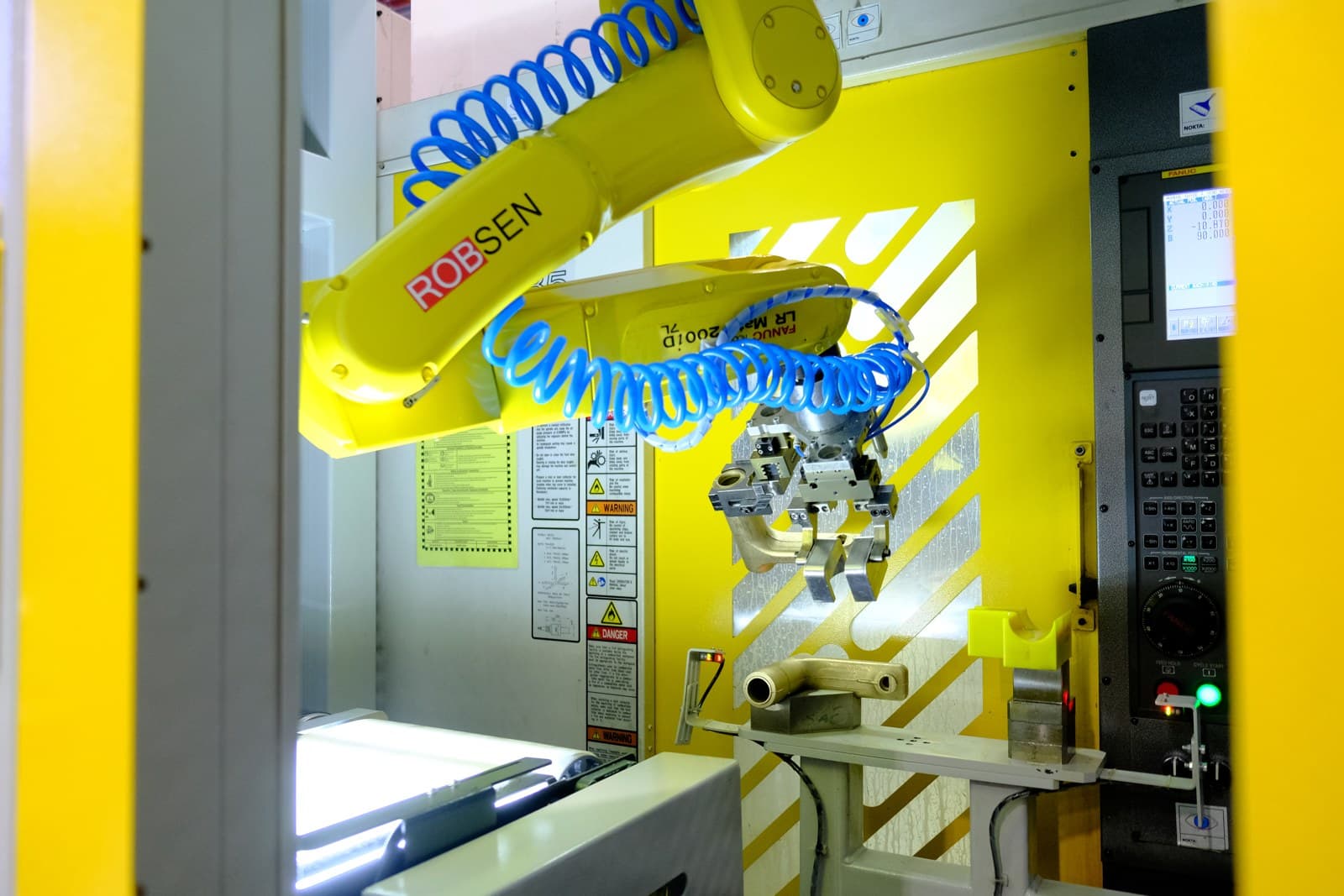
IROCUBE MF Series machine-tending cell loading a brass part into a FANUC ROBODRILL machining center.
Back to that customer
When we develop these programs, we analyze the production interruptions our customers run into because they can't establish a data flow — and therefore the indirect costs that come with them.
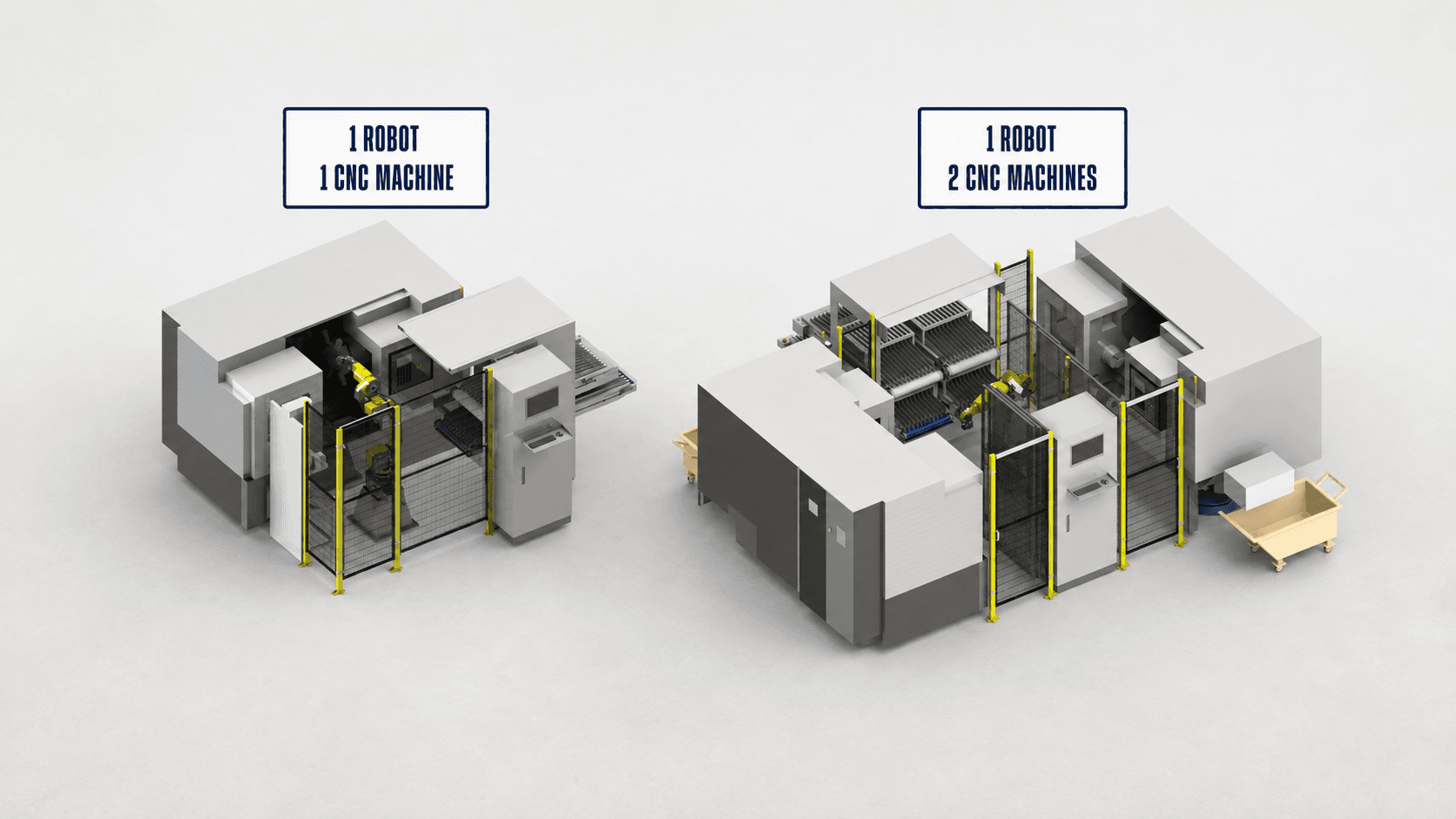
The customer I opened with is the typical case: CNC machines run manually, not enough production data in the process, and so no way to predict the maintenance interval correctly. What we did about it was specific. IROCUBE is the robotic feeding cell we developed for CNC machines; INOTIFY is the system monitoring software that comes with it. We added custom screens to INOTIFY.
We customize INOTIFY to each customer's needs, and those customizations let users watch the data they want to analyze in real time. Those screens show how many parts have been machined since the last maintenance, how long the machine has run since the last tool change, and so on.
Small thing to build. Not a small thing to know.
Which brings us to the hard part
Indirect costs are genuinely difficult to identify. But when manufacturers establish a reliable data flow alongside a robotic automation investment, they gain a real advantage in getting ahead of those costs.
So it's worth taking the manually-fed CNC example and examining, under a few headings, exactly how the indirect costs arise there. Three of them come up most often:
- Can you actually measure what your CNC machines are doing?
- Can you quote a delivery date you'll hit?
- Can you tell a customer what they're getting, part by part?
Each one costs money in a way that never appears as downtime on a report.
That's the next post.
→ You may have the capacity. Can you prove it?
Could robotic machine tending reduce avoidable interruptions in your CNC process?
IROCUBE MF Series cells combine automated part loading with INOTIFY production monitoring. Together, they can reduce interruptions related to manual handling and provide clearer data on cycles, stops, part counts, and maintenance intervals.
If you are evaluating this approach for your production process, tell us which CNC operation you want to improve and where interruptions occur. Ferhad Kaleli and the Robsen engineering team can discuss the application with you.
Sources
- Siemens / Senseye, The True Cost of Downtime 2024 — PDF
- McKinsey & Company, Indirect manufacturing costs: An overlooked source for clear savings (2023) — mckinsey.com