

Table of Contents
- The Order That Never Appears on a Downtime Report
- Can You Measure Your Actual CNC Capacity?
- Why MES Stop Data Still Needs Reliable Reason Codes
- What This Does to Your Cost per Part
- What Your Records Show and What They Miss
- Part-Level Traceability: From Leak Test to Serial Number
- Three Questions Your Production Data Should Answer
In this article
- Why nominal CNC capacity is not the same as the capacity you can confidently promise to a customer.
- How missing cycle, labor, setup, and MES downtime-reason data distort delivery commitments, cost per part, and quotations.
- How automated part-level traceability connects production and quality data to each component and reveals process drift early.
A customer is considering an order for 100,000 parts to be delivered over the next six months — an average of approximately 16,700 parts per month. You have previously achieved an output of 20,000 comparable parts in a single month. Based on that production history, the order appears to be within your capacity.
But can you confidently commit to the delivery date?
That depends on whether you can explain how the earlier 20,000-part output was achieved. How many operators and shifts supported it? Was overtime required? How much time was spent on loading and unloading, setups, tool changes, waiting, and short stops? Are the same labor and shift resources available today?
The historical output suggests that the capacity may exist. Reliable production data determines whether that performance can be repeated and sustained.
The 100,000-part order is not for a single item; it consists of 20 different part numbers. Some variants may share fixtures or tooling, while others may require separate setups and tool changes. Without verified changeover and production data for each part family, the total delivery estimate still rests on assumptions.
The Order That Never Appears on a Downtime Report
Some production losses never appear on a downtime report. No machine breaks down, no alarm is triggered. You simply cannot verify the delivery commitment, so you cannot confidently accept the order.
A later capacity review may well show that your existing machines could have met the customer's six-month window. But at the moment the customer needed a firm answer, that promise could not be supported with production data.
The order was not lost because something failed. It was lost because the capacity existed on paper and could not be demonstrated with enough confidence to commit to it.
The financial impact is real, but the event itself is never recorded. Production never started, so there is nothing to log. This is a commercial consequence of missing production data, not a maintenance problem.
Capacity you cannot verify is capacity you cannot confidently sell.
Can You Measure Your Actual CNC Capacity?
The same CNC cell produced 10,000 good parts in one month and 8,000 in another, although its nominal machine capacity had not changed. Can your records explain the 2,000-part gap?
Total output is usually the easy number to find. The harder one is where the difference went.
You know the CNC's nominal machining cycle time. But what was the actual elapsed production time per good part? That figure has to absorb everything the machining cycle does not see:
- Loading and unloading
- Operator availability and shift coverage
- Setups and tool changes
- The machine waiting for parts
- Minor stops, short enough that nobody records them
- In-process quality checks
None of these appear in the CNC program. All of them appear in the delivery date.
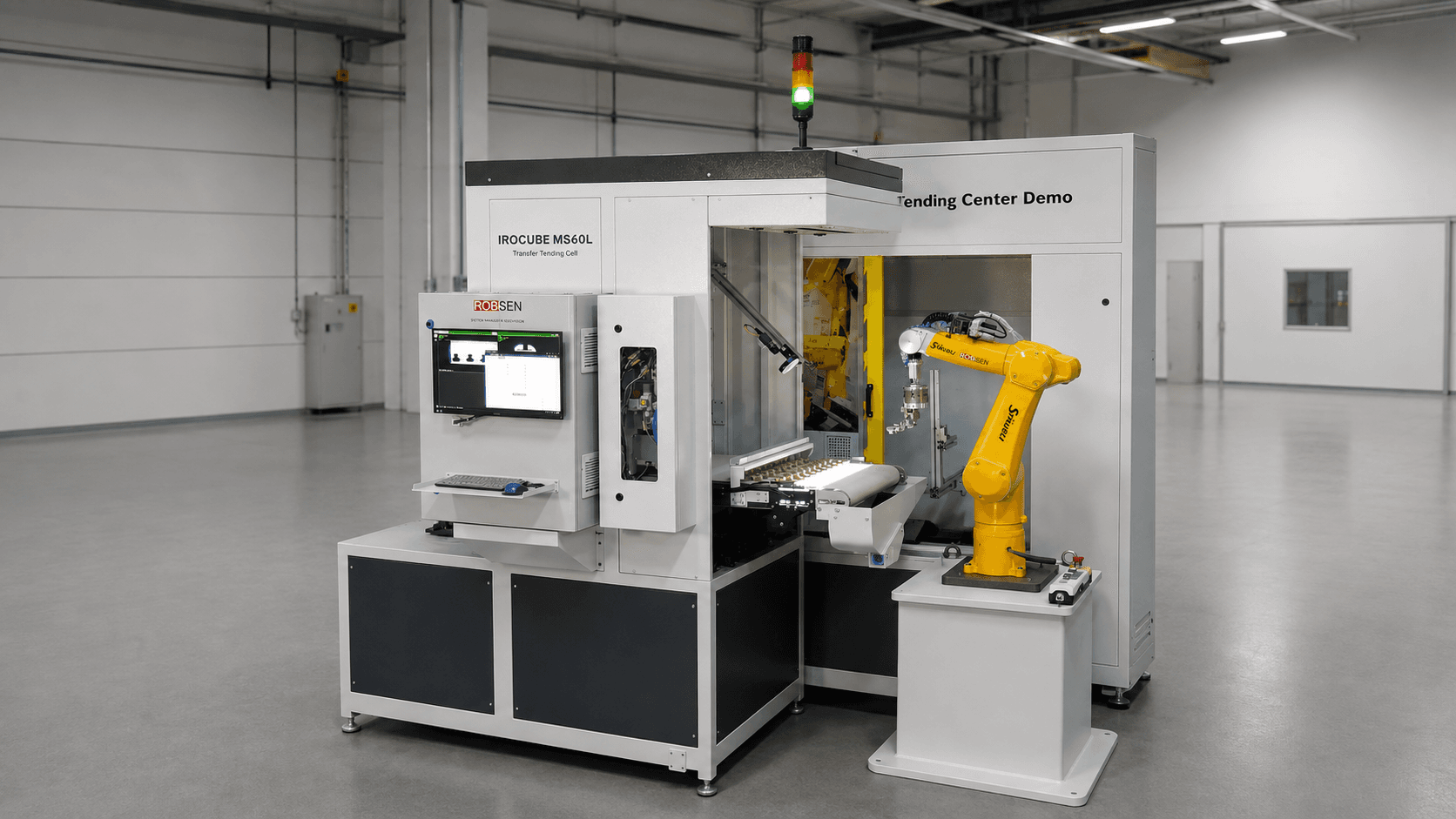
The IROCUBE MS60L robotic machine tending cell, ready for FAT at the Robsen workshop.
Why MES Stop Data Still Needs Reliable Reason Codes
A stop timestamp tells you when production stopped. It does not always tell you why.
Manufacturing execution software (MES) can store downtime reason codes, and some events can be captured automatically from the machine or its controller. But when classification depends on manual operator input, the explanation may be missing, delayed, simplified, or inaccurate.
A common example: a machine waited ten minutes because no new part was loaded. If that event is later entered as tool change or routine maintenance, the dashboard still contains a reason — but the reason points the production team toward the wrong problem.
This is not about operators being careless. Misclassification usually comes from the system around them:
- Reason-code options that are vague or overlapping
- Entries made after the event rather than during it
- The nearest or easiest category winning over the accurate one
- Two operators classifying the same stop differently
A useful reason set separates causes that actually lead to different actions — a broken tool, unplanned maintenance, no raw part available, a setup overrun. Each one sends the team somewhere different. "Machine stopped" sends them nowhere.
Robotic systems change part of this picture. A robot controller and its cell software can record cycles, part transfers, alarms, test results, and defined system events automatically. That reduces how much of the record depends on memory and manual entry.
It does not remove human judgment. A stop caused by something outside the cell still has to be explained by someone. The distinction worth keeping is between events a system captures on its own and causes that still need a person to classify them.
What This Does to Your Cost per Part
These gaps do not prevent you from calculating a cost per part. They make the inputs unreliable.
If actual labor time, setup losses, machine waiting, and stoppage causes are missing or misclassified, the unit cost rests on assumptions rather than observed production. The quotation may still look precise to two decimal places. But an estimate built on assumed efficiency is not one built on measured production — and the number may be too low to protect your margin, or too high to win the order.
What Your Records Show and What They Miss
Production question | What is known | What is missing | Consequence |
|---|---|---|---|
Why 10,000 good parts one month and 8,000 the next? | Total output for each month. | Where the lost time went, and what caused it. | The next capacity estimate and quotation start from the wrong baseline. |
What was the actual elapsed production time per good part? | The nominal machining cycle time. | Loading, waiting, operator availability, setups, tool changes. | Delivery dates and cost per part rest on the wrong figure. |
Did the process begin to drift? | The final result — pass or fail. | The slow, continuous movement of values over time. | Intervention comes after nonconforming parts, not before. |
Why did the machine stop? | Stop time and duration, from MES. | The true cause, when classification is manual. | The team fixes the wrong problem. |
What is your real production capacity today? | Installed machines and theoretical machine hours. | Sustainable output with current operators, shifts, mix, and real losses. | You cannot price the order or commit to a date. |
Part-Level Traceability: From Leak Test to Serial Number
Say you machine a part on the CNC, wash it, and put it through a leak test. You can record the leak values at intervals and report them to the quality department. But on a 100,000-part delivery, manual records cannot tell your customer with certainty that every part met the leak-tightness specification.
Now suppose that process is automated with IROCUBE. A robot feeds the part into the CNC machine, washes the machined part, and runs the leak test. INOTIFY, our system monitoring software, records the test data in the background, generates a serial number, and writes it onto the part with laser marking. We build robotic systems for processes that touch metal, and a record like this is an ordinary part of how those cells are delivered.
Leak testing produces more than a pass-or-fail result. Each tested part has a pressure, a test duration, a leak value, a timestamp, and a production context. When those values are linked to a serial number, you can retrieve the evidence for one specific part instead of relying on a batch-level record. If a customer gives you a serial number, you answer with a production and inspection record rather than an assurance.
The value is not limited to customer audits. A single part may sit comfortably inside specification while a series of results moves gradually toward the tolerance limit. Normal variation always exists; a sustained trend is a different signal. Reliable time-series data lets production and quality teams investigate the process — the tool, the fixture, the parameters — before that drift starts producing nonconforming parts.
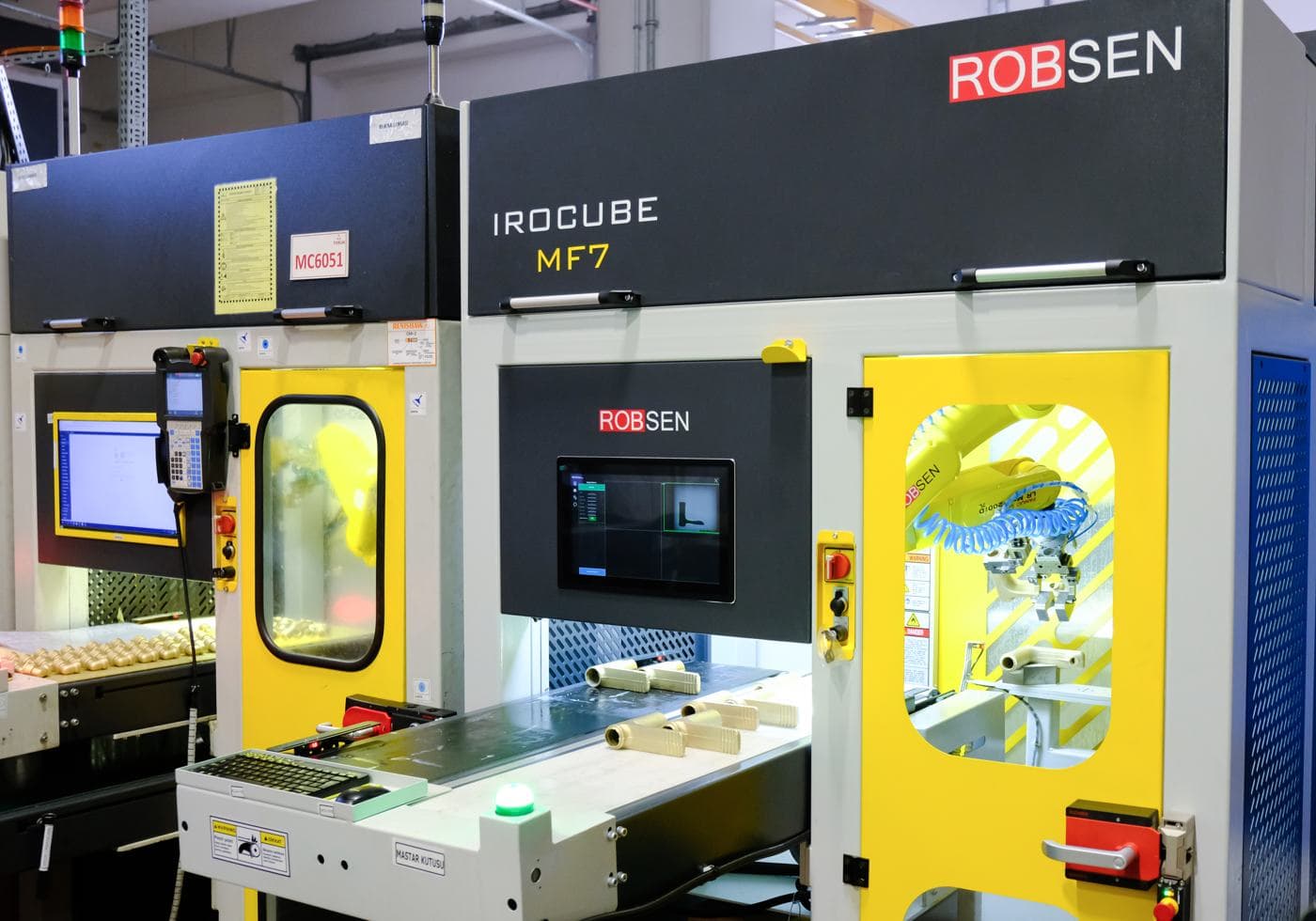
IROCUBE systems on a customer floor in faucet manufacturing.
Three Questions Your Production Data Should Answer
- If the same CNC cell produced 10,000 good parts last month and 8,000 this month with the same nominal capacity, can you explain the 2,000-part gap?
- If a customer requested 100,000 parts within a firm six-month delivery window, could you accept the order and defend the delivery date with production data?
- If a customer gave you the serial number of one part, could you retrieve its machining and leak-test record?
If one of those answers is uncertain, treat it as the beginning of a data audit — not as a verdict on your operation.
Start with one repeat part number. Map what is recorded automatically, what depends on operator input, and what is not recorded at all. That exercise will show whether your next capacity promise, quotation, and quality record are supported by evidence or by assumptions.