

Table of Contents
- A Robot That Waits Is Not Necessarily a Loss
- Where Is Value Being Created?
- Why One Robot Serving Several Machines Looks Attractive
- We Would Not Evaluate an Operator That Way
- When One Robot for Multiple Machines Is the Right Answer
- What Successful Automation Customers Do Differently
- The Payback Period Does Not Tell the Whole Story
- Why a Robot Integrator Should Care About This
In this article
- Why a constantly moving robot does not necessarily indicate an efficient production cell.
- How forcing one robot to serve too many CNC machines can create waiting time elsewhere in the system.
- When a multi-machine robotic cell is the right investment—and when it is not.
- Why the success of the first robotic cell matters to both the manufacturer and the robot integrator.
During a recent plant visit, we discussed automating a long-cycle CNC turning operation.
The proposed robot could load a part in approximately one minute. After loading two machines, however, it would wait while the machines completed their machining cycles. This created a concern for the manufacturer: if the robot was going to spend part of its time waiting, was the investment being fully utilized?
The team began looking for ways to keep the robot moving. Could it serve another machine? Could more operations be added to the cell? Would a linear rail allow the same robot to cover a larger group of CNC machines?
These are reasonable questions. Robot utilization matters when evaluating an investment. But it is not the first metric a manufacturer should optimize.
The first question should be:
Which equipment must keep running for the plant to produce more parts?
A Robot That Waits Is Not Necessarily a Loss
In CNC machine tending, the robot supports the production process. It loads and unloads parts, transfers them between operations, and creates a consistent production rhythm.
The CNC machine performs the machining operation that moves the part toward completion. If the robot finishes loading and waits while the spindle continues machining, production has not necessarily lost anything. The robot may simply have completed its task within the available service window.
The opposite situation is more important. If the CNC completes its machining cycle and waits because the robot is busy elsewhere, the plant is losing available production time.
This distinction changes the way a robotic cell should be evaluated.
An idle robot is not necessarily lost production. An idle spindle usually is.
A robot moving continuously may look productive. But if the machines around it are waiting, the cell is optimizing robot activity rather than production output.
This is a form of local optimization: one piece of equipment appears highly utilized while the overall system produces less than it could.
An idle robot is not necessarily lost production. An idle spindle usually is.
Where Is Value Being Created?
Consider a typical metal-production flow:
Forging → trimming → machining → washing → inspection → assembly → packaging
Each operation supplies the next one. Forging creates the parts that trimming must process. Trimming supplies machining. Machining supplies washing and inspection. Those operations ultimately support assembly and shipment.
In a machine-tending application, the robot helps this chain move with less manual variation and fewer interruptions. But the objective is not to maximize the robot’s motion. It is to support the value-producing operations at the speed and consistency the complete process requires.
That is why successful automation projects begin by identifying the production constraint.
Which operation determines total output?
Which machine creates the largest loss when it waits?
How frequently does each machine require service from the robot?
How much variation exists in machining cycles?
What happens to the other machines during a changeover or operator intervention?
Where is buffer capacity required?
The answers determine whether one robot should serve one machine, two machines, or a larger group.
The number of machines per robot should be the result of the production analysis—not the starting target of the project.
The number of machines per robot should be the result of the production analysis—not the starting target of the project.
Why One Robot Serving Several Machines Looks Attractive
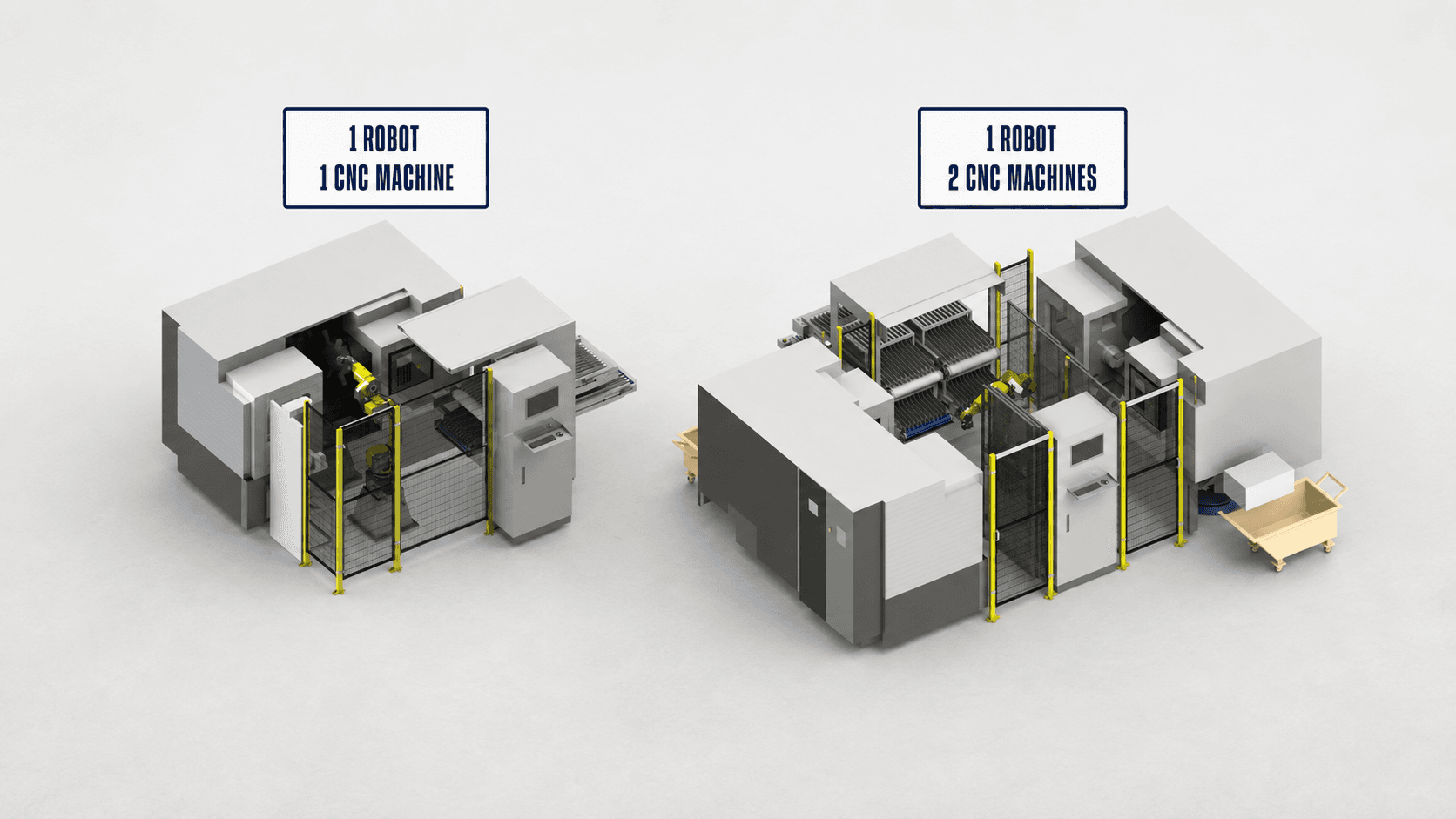
Suppose a production area contains three CNC machines, each currently supported by an operator.
A simple payback calculation may suggest placing one robot in the middle of the three machines. If required, a linear rail can be added so the robot can travel between them. One robot replaces several repetitive loading operations, which makes the initial labor-saving calculation look attractive.
This is particularly appealing when the investment is expected to pay for itself in less than one year—a target we frequently encounter in metalworking projects in Türkiye.
But an investment decision based only on the purchase price and the number of manual loading positions removed is incomplete.
The production dynamics must also be calculated:
Can two machines request the robot at the same time?
How long does the robot spend travelling between machines?
How much service-time margin remains when a cycle is delayed?
Are all machines producing the same part family?
How frequently are parts, fixtures, grippers, or tools changed?
Does an operator entering the shared safety area stop the entire cell?
Can a problem at one machine interrupt production at the others?
What happens to all three machines if the single robot stops?
A robot working close to its maximum service capacity has very little room to absorb variation. A delayed unloading operation, a difficult pickup, a changeover, or a short operator intervention can propagate through the entire cell.
The result can be visually convincing but operationally weak: the robot rarely stops, while CNC machines spend valuable minutes waiting for it.
The result can be visually convincing but operationally weak: the robot rarely stops, while CNC machines spend valuable minutes waiting for it.
We Would Not Evaluate an Operator That Way
If keeping the loading resource constantly busy were the only objective, a manufacturer could assign one operator to several machines and declare the labor problem solved.
The operator might walk continuously between the machines without a moment to stop. From a distance, this would look like excellent utilization.
But manufacturers do not evaluate the arrangement only by how busy the operator appears. They also ask whether each CNC is loaded on time, whether the operator can manage changes safely, and whether total output is maintained.
The same logic should apply to a robot.
Replacing the operator with a robot does not eliminate the need to balance service time, machine demand, changeovers, travel, safety access, and process variation. Automation makes these factors more consistent and measurable, but it does not make them disappear.
The goal is not to make the loading resource work continuously. The goal is to prevent the production constraint from waiting unnecessarily.
The status light that matters most belongs to the process that determines production output—not necessarily to the robot.
The goal is not to make the loading resource work continuously. The goal is to prevent the production constraint from waiting unnecessarily.
When One Robot for Multiple Machines Is the Right Answer
This argument does not mean that every CNC machine requires a dedicated robot.
We have designed and commissioned successful systems in which one robot serves multiple machines. A multi-machine architecture can be the correct solution when:
- Machining cycles provide sufficient time for the robot to serve every machine.
- Robot service times and travel times are known and repeatable.
- Simultaneous machine requests can be absorbed without significant waiting.
- Part families, fixtures, and grippers are compatible.
- Changeovers are infrequent or can be performed without stopping the entire group.
- Buffers provide enough production autonomy.
- The shared safety concept does not create unnecessary interruptions.
- A robot failure affecting several machines represents an acceptable operational risk.
A dedicated robot can also be the better solution when machine uptime, production independence, frequent product changes, or future scalability are more important than minimizing the number of robots in the first purchase order.
There is no universal answer. The correct architecture is the one that produces the strongest system-level result under the manufacturer’s actual operating conditions.
There is no universal answer. The correct architecture is the one that produces the strongest system-level result under the manufacturer’s actual operating conditions.
What Successful Automation Customers Do Differently
Some manufacturers progress rapidly with robotic automation. After the first cell, they approve the second, third, and later investments with greater confidence.
Their common characteristic is not simply a larger investment budget. They identify where their production system creates value and which operations must remain available.
They tend to:
- Prioritize total production output over robot utilization.
- Protect the uptime of the bottleneck process.
- Measure the production conditions before selecting the automation concept.
- Avoid making the first robotic cell unnecessarily complex.
- Design the first project as a repeatable model.
- Evaluate capacity, quality, labor availability, changeovers, and operational risk together.
- Use the results of the first installation to make subsequent investments faster and more accurately.
A successful first cell creates technical confidence inside the plant. Operators learn the system. Maintenance teams understand it. Management sees measurable production results. The next investment no longer feels like an experiment.
An overcomplicated first project can produce the opposite result.
A successful first cell creates technical confidence inside the plant.
The Payback Period Does Not Tell the Whole Story
Initial investment cost matters. Payback matters. No manufacturer should ignore either one.
But the shortest spreadsheet payback is not always the investment with the best operational return.
A concept using one robot for several machines may reduce the initial purchase cost. Yet if it causes machine waiting, couples previously independent processes, complicates changeovers, or makes a single failure affect an entire machine group, its indirect costs can continue for years.
Delaying automation also has a cost.
While a manufacturer searches for a concept in which the robot never waits and the payback calculation looks perfect, the plant may continue to face:
- Difficulty recruiting machine operators
- High employee turnover
- Training costs
- Dependence on additional shifts
- Variation between operators
- Lost production during breaks and shift handovers
- Capacity that cannot be used consistently
These costs do not remain fixed while the project is postponed. Some accumulate and make the operational problem progressively harder to solve.
The objective should therefore be neither “buy as few robots as possible” nor “install one robot at every machine.”
It should be:
Build the simplest automation architecture that protects production output, manages operational risk, and can be repeated successfully.
Build the simplest automation architecture that protects production output, manages operational risk, and can be repeated successfully.
Why a Robot Integrator Should Care About This
At this point, a reader may reasonably think that a robot integrator is simply trying to sell more robots.
It can sound that way.
An integrator may be able to reduce the initial project price by making one robot serve more machines. The payback calculation becomes shorter, the first purchase looks more attractive, and the project may be easier to sell.
But the only sustainable way for a robot integrator to grow is for the customer’s first investment to create enough value to justify the next one.
If an undersized or incorrectly structured robotic system causes machine waiting, difficult changeovers, recurring interruptions, or lower-than-expected output, the customer may stop investing in automation.
The customer may not conclude that one particular system architecture was wrong. They may conclude that robotics does not work for their production.
When that happens, the integrator does not merely lose the follow-up order. A poorly designed project can also close the customer’s door to other integrators and future automation technologies.
That outcome benefits nobody.
A productive first cell, followed by a second and third investment, is better business for the manufacturer and the integrator. The manufacturer gains capacity, consistency, and operational confidence. The integrator earns repeat business by creating measurable value rather than by maximizing the size or apparent utilization of the first system.
That is the alignment worth protecting.
A productive first cell, followed by a second and third investment, is better business for the manufacturer and the integrator.
The most profitable robotic project is not the one that keeps one robot looking busy. It is the one that makes the customer confident enough to build the next cell.
When evaluating a CNC machine-tending project, do not begin by asking how to keep the robot moving every second.
Begin by asking which process must not wait.
Then design the robot around that answer.
Begin by asking which process must not wait. Then design the robot around that answer.