
Table of Contents
- Why a Five-Second Feeding Cycle Requires Careful Engineering
- The Part Could Not Be Treated Like a Standard Nut
- An Earlier Failure Had Become an Organizational Memory
- The Customer Deliberately Chose the Simpler Concept
- Internal Full-Cycle Test Before Customer FAT
- The Operator Was Still There—So What Did the Investment Achieve?
- The Specification Became the Shared Memory of the Process
- The Customer and Integrator Were Both Evaluating Each Other
- The First Project Became the Beginning
In this article
Why a previous automation failure can create an organizational challenge long after the equipment is gone.
What makes a four-to-five-second transfer-machine feeding cycle difficult.
Why the simplest concept can be the right first investment—even without immediate labor reduction.
How written requirements, shared learning, and a successful first cell created the foundation for follow-on projects.
What would you think if I told you that we delivered a robotic cell sixteen weeks after receiving the order—but that reaching the investment decision had taken two years?
The project delivery was not the long part. The long part came before the order.
For two years, the customer and our team remained in active contact. We evaluated different concepts, prepared simulations, revised designs, discussed technical risks, and worked through detailed specifications and commercial expectations.
This was not an opportunity that disappeared and returned two years later. It was a continuous sales and decision process in which both sides were trying to answer the same question from different positions:
Is this the right automation concept—and can we trust each other to make it work?
Once the scope and expectations were agreed upon, we delivered the robotic cell in sixteen weeks.
For the Robsen team, the period leading to that order became one of the longest and most demanding automation sales cycles we had experienced. The final cell may look relatively simple to someone walking through the plant today. Understanding why that simplicity mattered requires starting with the machine, the part, and the customer’s previous experience with automation.
Why a Five-Second Feeding Cycle Requires Careful Engineering
The project involved feeding forged metal parts into a transfer machine.
A transfer machine moves parts through multiple machining stations. Several components are processed simultaneously at different positions inside the machine. Once the complete sequence is loaded, every index can release one finished part and request a new raw part.
This creates an important distinction. A component may undergo several operations and spend considerable time inside the machine, but the feeding system may still need to present a new part every four or five seconds.
In this application, the required cycle was approximately 4.5 to 5 seconds.
Meeting that cycle requires more than programming a fast robot movement. The complete feeding process must work within the same window:
Separate one part from the incoming supply
Prevent uncontrolled rolling or overlapping
Determine the part’s position and orientation
Pick it securely
Compensate for dimensional and positional variation
Load it into the transfer machine
Confirm that the loading operation has been completed correctly
By the time this opportunity began, we had already commissioned more than fifteen robotic feeding cells for transfer machines. The application type was familiar to us.
The customer’s part, however, introduced a specific challenge.
The Part Could Not Be Treated Like a Standard Nut
The parts were forged, but they did not undergo a separate trimming operation before machining. As a result, a certain amount of residual flash remained on each component.
That flash was not identical on every part. Its form, position, and dimensions could vary.
Previous feeding concepts had relied on vibratory and linear feeding systems. The irregular flash caused parts to catch in the feeding channels and prevented them from moving consistently.
The same variation created another challenge on a conveyor. The component had a hexagonal form, but it could not stand reliably on the expected face because residual flash changed its resting position. Some parts leaned in different directions; others could roll.
This meant the feeding system could not assume that every part would arrive in one stable orientation.
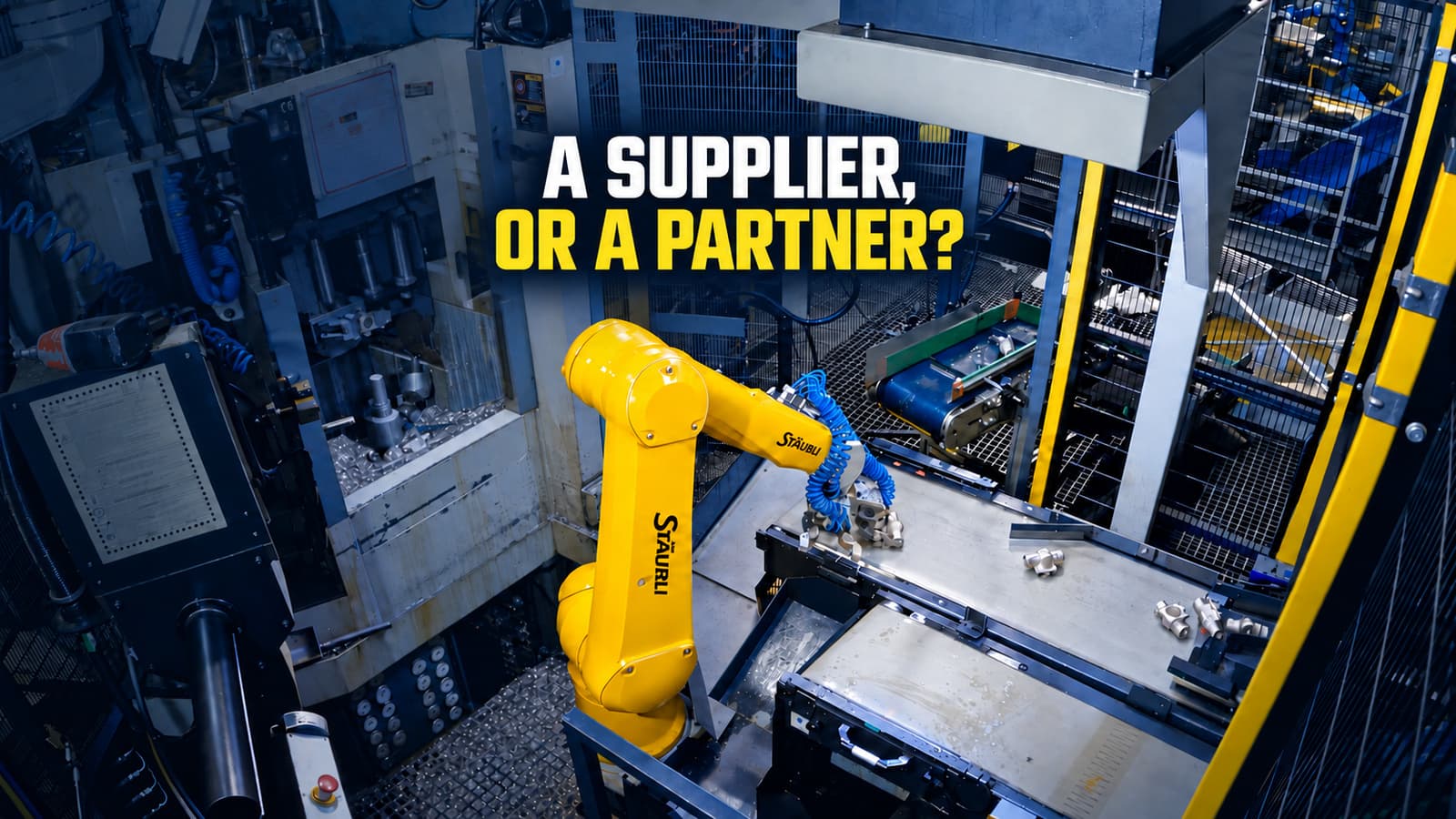
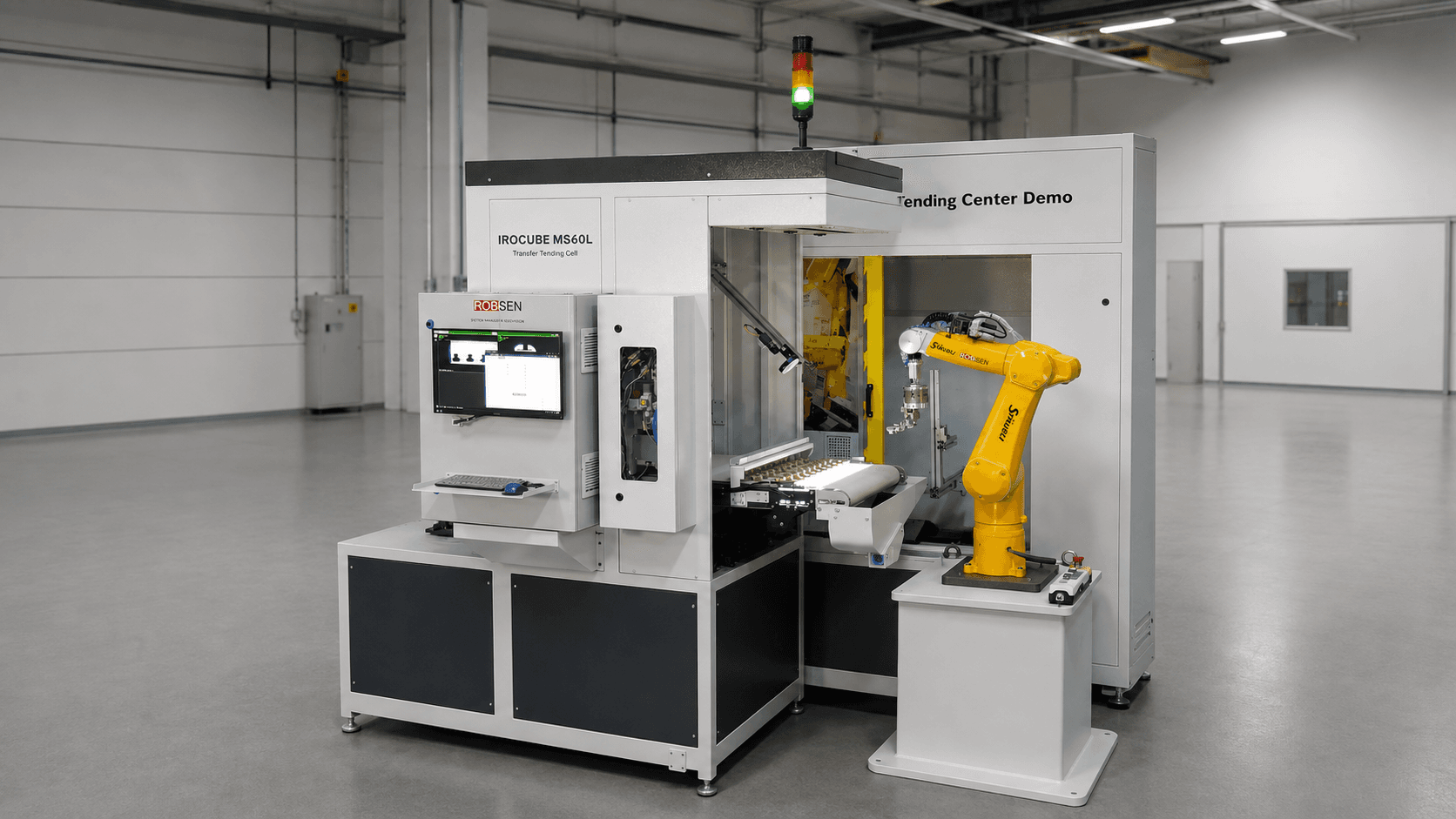
Our concept used a conveyor with separators that limited uncontrolled movement and prevented the parts from rolling freely. A vision system identified the position and orientation of each component, allowing the robot to approach it correctly.
The complete solution also required work on the robot gripper, robot trajectories, vision models and calibration, robot-camera coordination, compensating tooling, and the unloading mechanisms inside the transfer machine.
The engineering challenge was not simply moving the robot quickly enough.
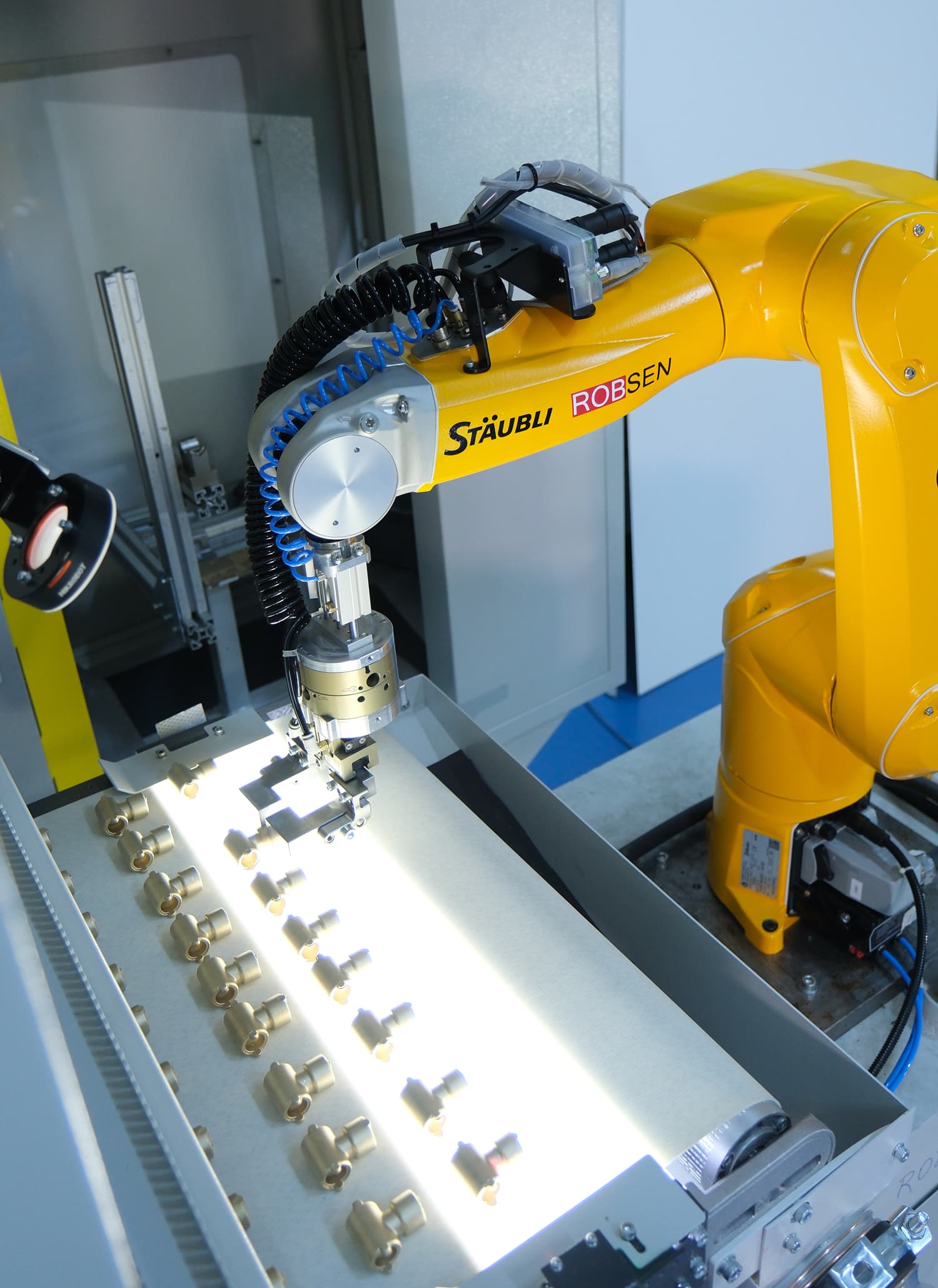
The illuminated conveyor presents separated components to the vision system. The robot then uses a compensating gripper to handle variations in the parts' resting positions.
It was presenting an irregular part, finding it reliably, picking it safely, and loading it within the transfer machine’s cycle.
An Earlier Failure Had Become an Organizational Memory
The previous feeding systems had not achieved the reliability the production process required.
Their effect lasted longer than the equipment itself.
When robotic automation returned to the agenda, the customer’s team approached the opportunity carefully. Operators, technicians, engineers, production managers, purchasing specialists, and senior management all wanted to understand how the new concept would avoid the difficulties they had already experienced.
This reaction was reasonable. A disappointing automation investment does not remain only a technical failure. It can change how an entire organization evaluates future projects.
The next integrator is no longer asked only to demonstrate that its own system can work. It must also overcome the memory left by the previous system.
Automation must earn the confidence of everyone who will operate, maintain, approve, and depend on it.
Different groups require different forms of evidence.
An operator wants to know what happens when a part arrives in an unexpected position. Maintenance wants to understand recovery after a fault. Engineering wants to verify the cycle and technical limits. Purchasing needs a clear scope. Management needs confidence that the investment can create a stable foundation for future automation.
That is why we approached each stage of the sales process with different simulations, designs, technical explanations, and tests.
The Customer Deliberately Chose the Simpler Concept
A more automated bulk-feeding system could have been considered.
A large container could be emptied into a dosing system. Vibratory and linear feeders could then separate and transport the parts toward the robot. In theory, such a system could provide much longer autonomous production and reduce the need for frequent operator loading.
The customer understood that possibility. It also understood the risks.
The part still had variable residual flash. Earlier feeding concepts had already failed to achieve the required reliability. The customer’s operators and technical team were also at the beginning of their practical experience with robotic systems.
Instead of trying to automate every part of the process immediately, the customer chose the simplest feeding method that could provide a reliable first result.
An operator would load parts onto the conveyor. The conveyor and its separators would control their movement. The vision system would determine their positions, and the robot would feed the transfer machine.
The resulting buffer provided approximately 10 to 15 minutes of production autonomy.
This was not the concept with the greatest possible labor reduction. It was the concept that allowed the customer and integrator to control the most important technical risks.
The simplest concept is not always the final architecture. Sometimes it is the safest path to the first successful result.
Internal Full-Cycle Test Before Customer FAT
Before inviting the customer to the Factory Acceptance Test, the Robsen engineering team ran the complete operating sequence internally. This recording shows the IROCUBE MS60L performing a continuous cycle so that part presentation, vision-guided localization, robotic handling and cycle consistency could be observed together.
Confidentiality note: Customer-specific production parts are not shown in this published video. We used a different, non-confidential component for the recording so the cell's complete operating sequence could be demonstrated without disclosing customer product information.
The Operator Was Still There—So What Did the Investment Achieve?
Someone visiting the plant today might be surprised.
A robot feeds a transfer machine operating at a cycle of approximately five seconds, but an operator still needs to supply parts to the conveyor. The available buffer is measured in minutes rather than hours.
At first glance, the expected labor-saving benefit of robotic automation is difficult to see.
But direct labor reduction was not the only objective of this first investment.
What is immediately visible | What the investment actually created |
|---|---|
An operator still supplies the conveyor | Practical experience with robotic production |
The buffer provides 10–15 minutes of autonomy | A repeatable 4.5–5-second feeding process |
Immediate labor reduction appears limited | Greater technical and organizational confidence |
The feeding concept looks relatively simple | Working knowledge of vision, robotics, and machine integration |
The first cell has a deliberately limited scope | A proven foundation for additional automation projects |
During commissioning, the customer’s team gained practical experience in areas such as:
Robot trajectory teaching
Gripper-finger design
Vision-system calibration
Vision-model configuration
Robot-camera coordination
Compensating tooling
Transfer-machine loading and unloading mechanisms
Fault recovery and daily operation
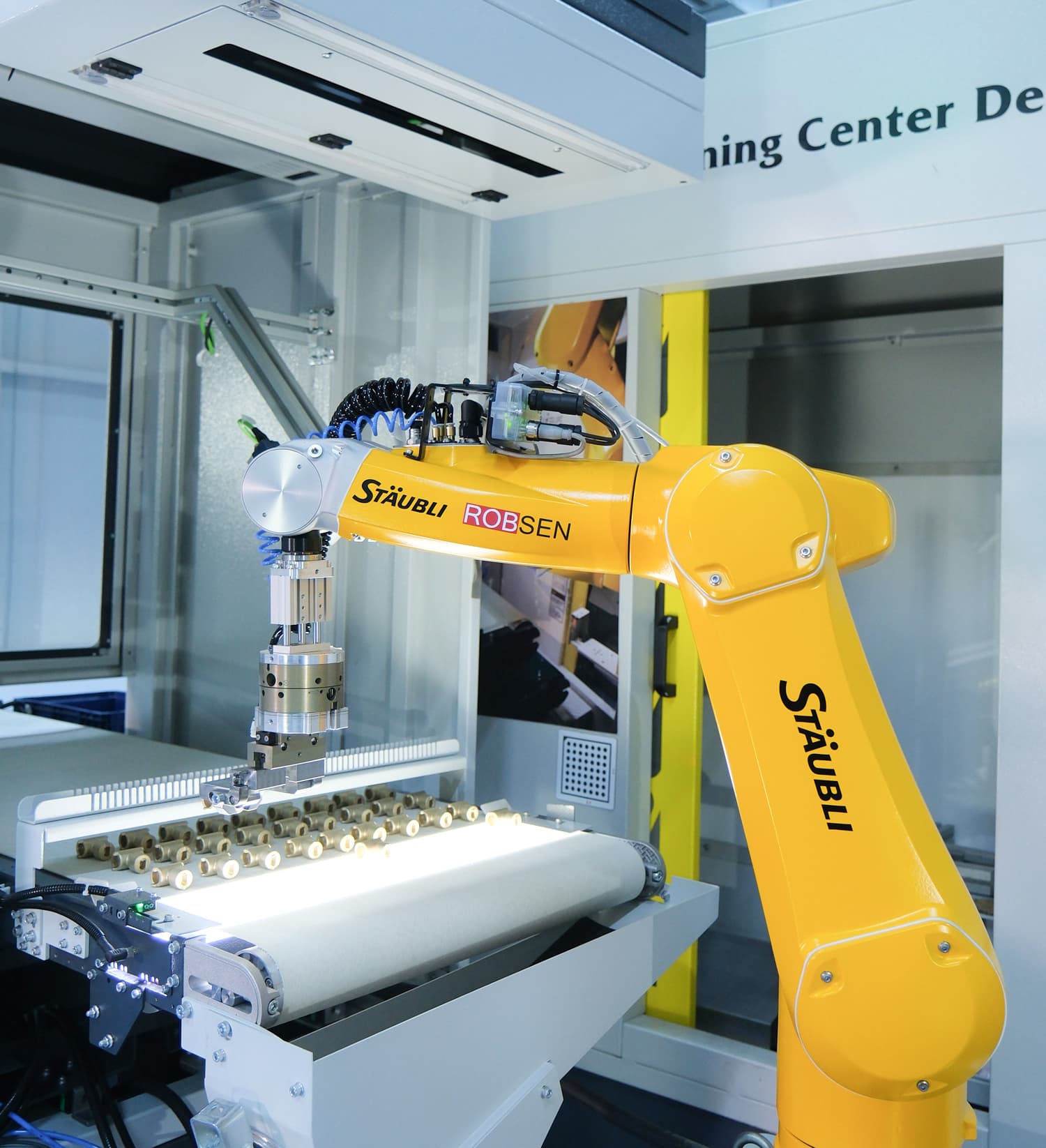
The deliberately simple conveyor–vision–robot arrangement gave the customer's team practical experience with robot operation, vision calibration, part handling and fault recovery.
This knowledge could not have been created by a presentation or simulation alone. It developed while the customer and our engineers worked on a real production system together.
The cell did not immediately remove an operator from the process.
It removed uncertainty from the next investment.
The Specification Became the Shared Memory of the Process
The customer’s expectations regarding specifications and contracts were more detailed than those we had encountered in many previous opportunities.
We prepared and reviewed dozens of pages of technical requirements and contractual conditions before the project entered its delivery stage.
This required time and discipline from both sides. But it also created an important advantage: expectations were written down before the order was finalized.
The specification clarified:
What the system was expected to do
Which part variations it needed to handle
How cycle time would be evaluated
What would constitute successful operation
How responsibilities would be divided
Which conditions were outside the agreed scope
How acceptance would be performed
Across a two-year sales and decision process, people can remember earlier conversations differently. Teams change, assumptions evolve, and technical decisions can lose their original context.
Written requirements gave both organizations a common reference.
The specification was not administrative overhead. It became the shared memory of a long decision process.
The customer’s discipline in documenting its expectations ultimately helped us enter the delivery stage with clearer acceptance criteria and fewer unresolved assumptions.
The Customer and Integrator Were Both Evaluating Each Other
Long sales cycles create a natural tension.
The integrator may wonder whether the simulations, designs, meetings, and pre-sales engineering work will eventually become an order. The customer may wonder how it can trust an integrator without asking difficult questions and examining several alternatives.
Both concerns are legitimate.
The customer needs enough evidence to justify the investment. The integrator needs to respond to evolving requirements while protecting the engineering capacity required for confirmed projects and other active opportunities.
Our team deserves significant credit for maintaining that balance. They continued to respond to detailed customer requests without losing control of the technical objective or the company’s available capacity.
At the same time, the customer remained engaged. The decision process was demanding, but communication did not disappear.
Trust developed gradually through consistent contact, written requirements, simulations, technical responses, and the willingness of both teams to continue working through difficult points.
The order was not the beginning of the relationship. By the time the order arrived, much of the relationship had already been built.
Once that decision was made, the long sales stage gave way to a clearly defined delivery project.
The First Project Became the Beginning
Today, the robotic cell is operating successfully at the customer’s plant.
More importantly, the customer’s team now has practical experience with a technology it previously approached with significant caution. Concepts discussed during the two-year sales and evaluation period are now creating new project requests for other machines.
Some of those follow-on projects have already progressed to approval.
This changes how we evaluate the return from the first cell.
If we considered only immediate operator reduction, the project might appear limited. But its wider results include:
A stable feeding process for a challenging part
A proven robot and vision concept
A customer team capable of working with the technology
Clearer internal expectations for future automation
Greater confidence between the manufacturer and integrator
A foundation for additional robotic investments
The first project did not attempt to deliver the maximum possible automation. It created the conditions required for the customer to continue automating successfully.
That was the more strategic result.
A first robotic cell should not be judged only by the operator position it removes. Sometimes its greatest return is the technical knowledge, operational confidence, and mutual trust that make the second project possible.
The best first automation project is not always the most ambitious one. It is the one that gives the customer a reliable reason to continue.