
Table of Contents
In this article
- Why every additional quality-control request can introduce new engineering challenges and change the cost, risk, and architecture of a robotic cell.
- How to select Phase One according to customer risk and business impact.
- Why phased implementation does not divide engineering costs into equal parts.
- How to prepare for future functions without installing everything in the first project.
A robotic quality-control project often begins with one clear problem.
In one recent project, a cosmetics manufacturer needed to prevent empty or underfilled tubes from reaching its customers. The proposed process was straightforward: pick each finished product, weigh it on a precision scale, reject anything below the specified limit, and allow accepted products to continue through production.
The requirement was technically achievable. Its boundaries could be defined, its cycle time could be calculated, and its acceptance criteria could be tested. Based on the manufacturer's original objective, the project was also commercially feasible.
Then the project became visible across the organization.
Could the same robotic cell detect a missing cap? Could it identify a cap that was cross-threaded or closed at an angle? Could it inspect the position of the label, determine whether its edges were fully attached, and verify that the printed information was readable? Could it also detect scratches, cracks, paint defects, and other cosmetic imperfections on the tube?
Every request addressed a legitimate quality concern.
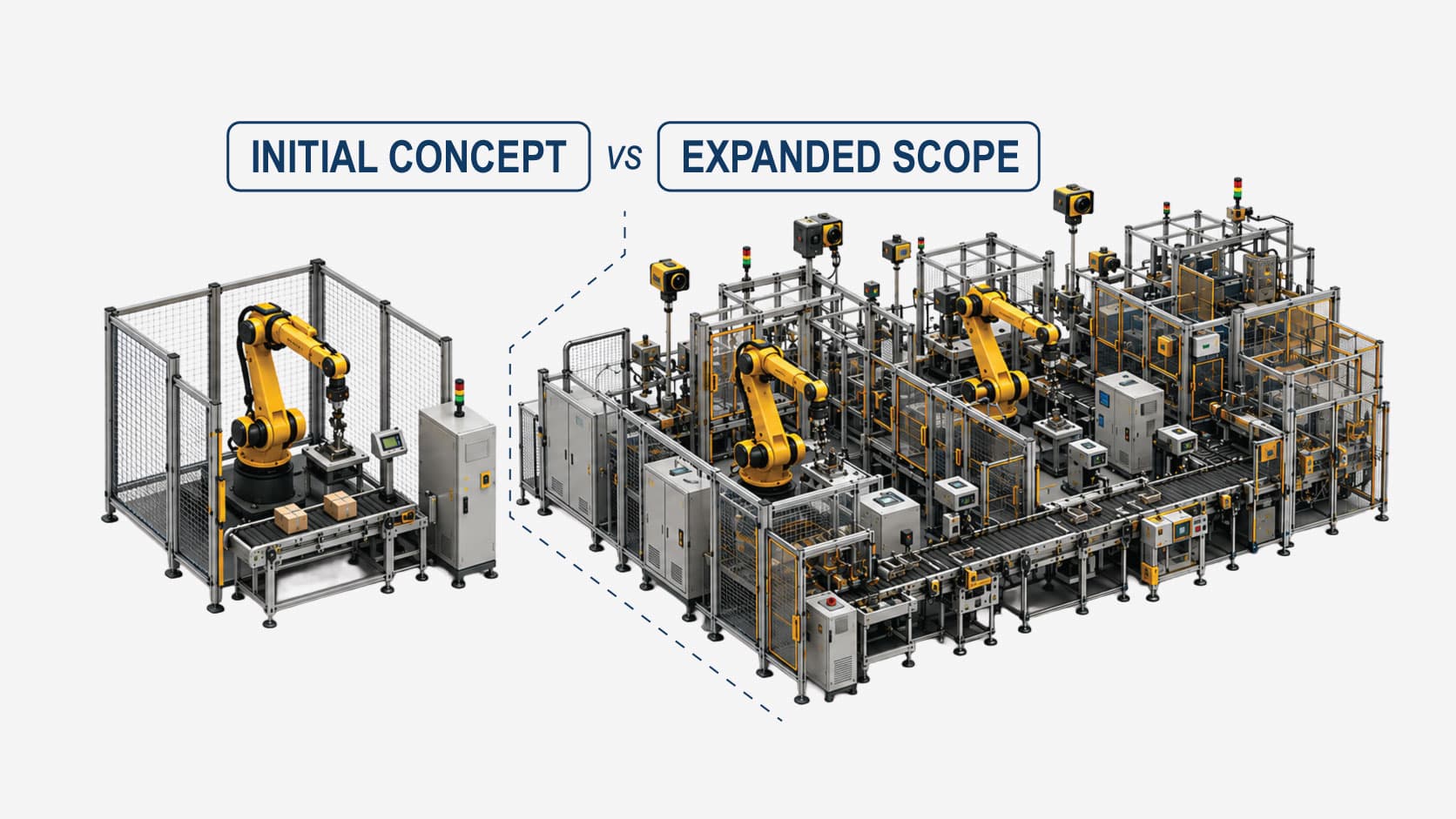
But together, they introduced several distinct engineering challenges and no longer described the same automation project.
When One Quality Check Becomes Several Inspection Systems
It is easy to assume that every new quality check is simply another option added to the same robot. In practice, each request may introduce a different sensing, handling, software, and validation challenge.
The difference becomes clearer when each quality request is translated into an engineering requirement:
Inspection requirement | What it may actually require |
|---|---|
Underfill detection | Precision scale, stable part handling, tolerance logic, and a reject path |
Cap presence | Camera, presence sensor, or profile inspection |
Misaligned or cross-threaded cap | Multiple viewing angles, part rotation, or profile/3D measurement |
Label position | Machine vision, reference-point detection, and recipe management |
Incomplete label adhesion | Controlled illumination, surface imaging, and additional camera angles |
Print readability | OCR/OCV, sufficient camera resolution, contrast control, and validation rules |
Cosmetic surface defects | Multi-angle imaging, specialized illumination, defect classification, and verified defect samples |
The same product is being inspected, but these do not necessarily represent the same engineering challenge.
Some functions may share cameras, lighting, or handling equipment. Others may require a new inspection position, a different part orientation, or a separate station. Each addition can also affect the robot path, gripper design, cycle time, control software, data storage, and acceptance testing.
This table should therefore not be read as a list of equally priced options. One requirement may fit easily into the existing architecture; another may introduce a significant technical challenge and change the complete system.
Technical possibility does not automatically mean project feasibility.
What Should Be Included in Phase One?
The solution is not to prevent requirements from changing. New requirements often emerge as quality, production, maintenance, and management teams become involved in the project.
Nor should the integrator dismiss these requests simply because they were not part of the first meeting. The additional requirements may be important, and some may eventually need to be automated.
The better approach is to separate the complete automation roadmap from the functions that must be commissioned in Phase One.
In the cosmetics example, the most consequential problem was clear: empty or underfilled products were reaching the customer. This resulted in returns and placed the manufacturer in a difficult position with its own customers.
The first phase therefore needed to answer one question reliably:
Does every finished tube contain the required amount of product?
This does not mean that cap, label, print, and cosmetic inspection are unimportant. It means that the first phase should solve the failure mode creating the greatest immediate customer and business risk.
Possible inspection functions can be prioritized according to:
- Severity of the failure
- Frequency of occurrence
- Ability to detect it with the current process
- Customer-return and quality costs
- Technical maturity of the proposed solution
- Effect on production cycle time
- False-accept and false-reject risk
- Validation and commissioning requirements
This allows the manufacturer and integrator to distinguish among three categories:
- Functions required for the first phase to create value
- Functions planned for later phases
- Optional functions that still require technical or commercial justification
Phase One then becomes focused enough to commission successfully without losing sight of the wider quality-control objective.
Phase the Functions, Not the Architecture
Dividing a project into phases does not mean treating each phase as an unrelated machine.
A cap-inspection camera may not be installed until Phase Two, but if that requirement is already known, its future position may need to be considered during Phase One.
Will the camera require another view of the product? Must the part be rotated? Is there sufficient space for the camera and lighting? Does the robot have the necessary reach? Will the inspection increase the cycle time? Are additional inputs, outputs, network connections, and control capacity required?
If these questions are ignored, adding Phase Two may require rebuilding mechanical, electrical, safety, and software elements that were completed during Phase One.
The functions can be commissioned at different times. The underlying architecture must account for where the project may go.
Share the complete roadmap early. Commission it in controlled phases.
This does not mean buying every future component immediately. It means making proportionate preparations for functions that are sufficiently likely and clearly defined.
Depending on the application, those preparations may include:
- Reserving physical space for another station
- Maintaining robot reach to a future operation
- Providing spare electrical and control-panel capacity
- Planning additional PLC inputs and outputs
- Preparing network and data interfaces
- Leaving cycle-time margin
- Designing conveyors and buffers for expansion
- Including future access requirements in the safety concept
- Creating software and recipe structures that can accept new functions
A future function does not need to be installed today. But it may need to be designed for today.
Why Phase One Usually Carries More of the Cost
Manufacturers sometimes expect a project divided into two phases to produce two equal project costs.
In practice, Phase One usually contains most of the common infrastructure:
- Robot and controller
- Safety equipment
- Mechanical structure
- Conveyors and part-handling equipment
- Electrical panel and PLC architecture
- Production-line integration
- Core software
- Initial engineering and risk assessment
- Testing and commissioning of the complete base process
Phase Two may add a new inspection function to an operating platform that already contains much of what it needs.
For that reason, a project representing 200 units of total investment may not be divided into two phases of 100 units each. Phase One may represent 150 units because it establishes the shared platform. Phase Two may represent 50 units because it adds functionality to that platform.
This does not mean the later phase is being charged in advance. It means that some of the engineering decisions and physical infrastructure required to keep Phase Two possible must be completed during Phase One.
The opposite approach may initially appear less expensive. But if Phase One is designed without considering known future requirements, the later addition can become a retrofit. Moving conveyors, expanding safety fences, changing the electrical panel, replacing the robot, or redesigning part flow may cost far more than planning the interface correctly at the beginning.
A phased project does not divide cleanly through the middle because its infrastructure is shared.
A phased automation project is not several unrelated projects. It is one architecture commissioned in controlled steps.
Design Today for What You May Install Tomorrow
The same principle applies beyond quality inspection.
Consider a robotic palletizing project. Today, operators may remove completed pallets with a forklift or pallet truck. In a future phase, the manufacturer plans to use autonomous mobile robots to transfer those pallets.
The AMRs will not be part of Phase One. However, their future requirements can affect decisions being made today.
The pallet may need to be placed at a specific height so the AMR can collect it. That may require a platform or a dedicated transfer interface. Raising the pallet changes the height of the complete stack, which affects whether the palletizing robot can reach the top layer.
The future AMR also influences:
- Pallet orientation
- Approach direction
- Transfer clearances
- Floor layout
- Safety zones
- Communication interfaces
- Robot reach calculations
Waiting until Phase Two to consider these requirements may reveal that the original palletizing cell cannot support the planned AMR without significant modification.
The AMR does not need to be purchased during Phase One. Its known interface requirements should still inform the Phase One design.
This is the difference between installing future equipment too early and protecting the ability to install it later.
A Successful Phase One Earns Phase Two
Phased implementation is especially valuable when a manufacturer is at the beginning of its robotic automation journey.
The first project creates more than a technical result. Production teams learn how to work with the cell. Maintenance teams develop new capabilities. Quality teams learn how automated acceptance criteria behave under real production conditions. Management begins to compare expectations with measurable outcomes.
If Phase One attempts to solve every quality challenge at once, the project takes on several different technical risks simultaneously. A challenge in any one inspection function can delay the commissioning and acceptance of the entire cell.
The original, commercially feasible project can become too expensive or too difficult to approve. The manufacturer is then left with exactly the problem it set out to solve: empty or underfilled products can still reach the customer because the first project never happened.
Phasing prevents secondary requirements and their engineering challenges from making the primary solution impossible.
It also gives both the manufacturer and the integrator an opportunity to learn from real production data before committing to the next level of complexity.
This does not mean hiding later costs or ignoring future needs. On the contrary, it requires the manufacturer to communicate the complete ambition as early as possible. The integrator must then distinguish between:
- What must operate on day one
- What must remain possible on day two
That distinction allows the first investment to solve a measurable problem while preserving a credible path toward a broader automation system.
Phase One does not need to solve every quality challenge in the factory. It needs to solve the most consequential problem reliably while preserving the physical, electrical, software, safety, and data architecture required for the next phase.
The best first phase is not the robotic cell that promises everything.
It is the one that solves the first problem well enough to earn Phase Two.