
In our previous article, we explored the concept of OEE (Overall Equipment Effectiveness) highlighting why this metric is critical when making investment decisions. We walked through an example based on a manually operated CNC machine and calculated an OEE score.
The biggest productivity gains don't always come from buying more CNC machines, they come from increasing the effectiveness of the machines you already own.
In that scenario, operated manually, the system reached approximately 60% OEE, based on 86.6% availability, 75% performance, and 92.4% quality rates.
Some manufacturers may find these figures low. It’s not uncommon to hear comments like “We don’t scrap 10 parts per shift” or “Our operators easily maintain 90% performance.” But even the most experienced teams can experience unexpected downtime due to tool breakage, raw material delays, work accidents, or overseas spare part lead times. These realities highlight the complexity of production and how susceptible it is to external disruptions.
Long-term data shows that an OEE score of 60% is not only realistic—but actually optimistic—for manually operated CNC machines in Türkiye. It’s also important to note that the example assumed one operator was dedicated to one machine. In practice, operators often manage multiple machines. When one person moves between stations, it becomes difficult to feed all machines continuously and efficiently, further impacting the OEE score.
The Impact of Robotic Loading on Production
What changes after robot integration?
1. Higher Availability
2. Stable Performance
3. Improved Quality
4. Better Machine Utilization
Let’s now take a closer look at how investing in robotic loading systems affects overall production performance.
Availability
Let’s assume the shift duration remains 480 minutes. With robotic loading, operator-related breaks such as lunch and rest pauses are eliminated. Instead, we account for just 10 minutes of planned downtime for basic cleaning and adjustments to the robot and CNC machine, thus increasing planned production time to 470 minutes.
If we factor in 15 minutes of unplanned downtime due to material handling or minor quality issues, plus 5 minutes of undefined stops, the net production time comes to 450 minutes.
Availability (%) = 450 / 470 = 95.7%
Performance
The greatest advantage of robotic loading systems is seen in the area of performance. Each part is loaded with a time optimized for the robot’s path and with consistent precision. This ensures that production cycle times become stable, predictable, and repeatable.
Prior to robotic investment, CNC machines often use manually clamped fixtures. Operators must tighten and release these fixtures by hand with each part change. With robot integration, pneumatic or hydraulic fixtures are typically installed, significantly reducing clamping time.
Additionally, conveyor-based cell designs allow for buffer storage of semi-finished parts. For example, a 30-part conveyor capacity with a 2-minute cycle time ensures 60 minutes of uninterrupted material flow. This enables operators to support other tasks or cells when needed.

Figure 1. Conveyor-based robotic loading enables continuous production while reducing operator intervention.
Given these advantages, let’s assume that within the 450-minute net production time, the theoretical maximum output rises to 245 parts. Based on six months of data, an average of 230 parts is produced per shift.
Under these conditions, the performance rate approaches:
Performance (%) = 230 / 245 ≈ 94%
Quality
The precision and repeatability of robotic systems significantly reduce part handling errors. Sensors used during loading verify the correct placement of each component. For instance, volumetric flow sensors used in CNC machines can detect whether hydraulic grippers have secured the part properly by monitoring flow rates. If an issue is detected, the system halts automatically, preventing defective production.
Let’s assume only 5 of the 230 parts produced per shift are scrapped—due to tool wear, process errors, or tight tolerances. This yields a quality score of:
Quality (%) = 225 / 230 = 97.8%
Our OEE Score in Robotic Systems Is Approximately 88%
With robotic loading, the OEE for this CNC machine is calculated as follows:
• Availability: 95.7%
• Performance: 94%
• Quality: 97.8%
Multiplying these metrics, the overall OEE score reaches approximately 88%. This robotic investment improved machine effectiveness by nearly 30 points. Crucially, this improvement was achieved without hiring additional staff or investing in new machines. It was realized within the same footprint, at a lower operational cost.
Compact Design, Scalable Growth
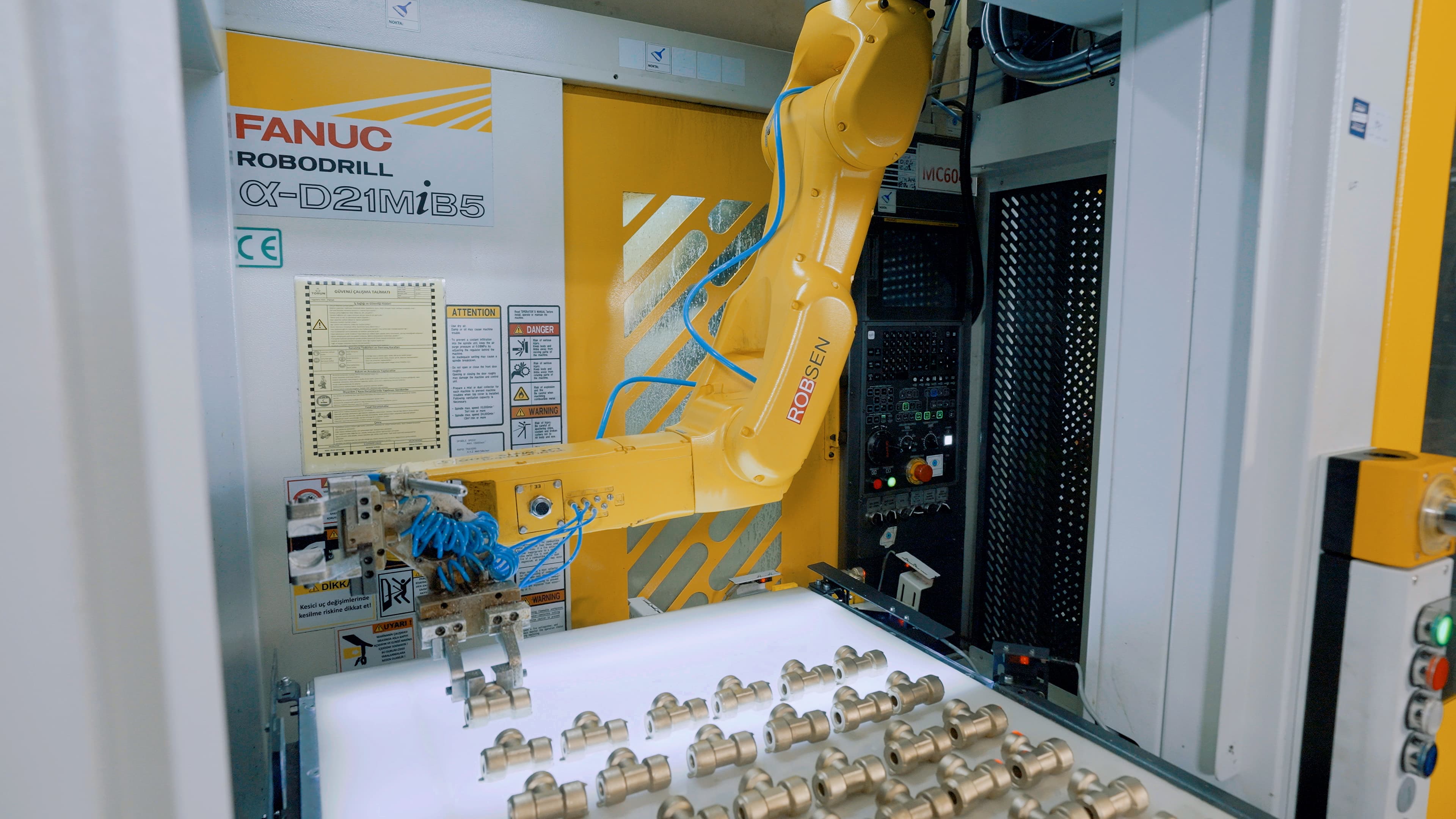
As Robsen’s design team, we develop robotic systems by considering machine footprints and operating principles. For example, our Irocube MF series, specially designed for Fanuc Robodrill, enables front-side loading and allows the systems to be lined up side by side. Compared to similar systems on the market, this results in a significantly more compact layout.
One of our customers invested in 60 Irocube units across their CNC lines and achieved a notable increase in efficiency. One operator was assigned to every five systems, not only feeding parts but also performing quality control and deburring tasks.

Figure 2. Compact robotic cells maximize production capacity while minimizing floor space.
When these responsibilities were later streamlined, it became possible for a single operator to manage ten systems simultaneously thanks to Irocube’s conveyor-based design. The stock space provided for semi-finished parts is sufficient to sustain production flow without interruption.
Automation is not about replacing people. It is about enabling the same workforce to achieve significantly higher output.
With the help of buffer capacity, operator workload is reduced, shift transitions become smoother, and a far more efficient production setup can be maintained with the existing workforce. As a result, by adding an extra shift, the operational capacity can be doubled, creating an opportunity for growth without the need for new machine investments.